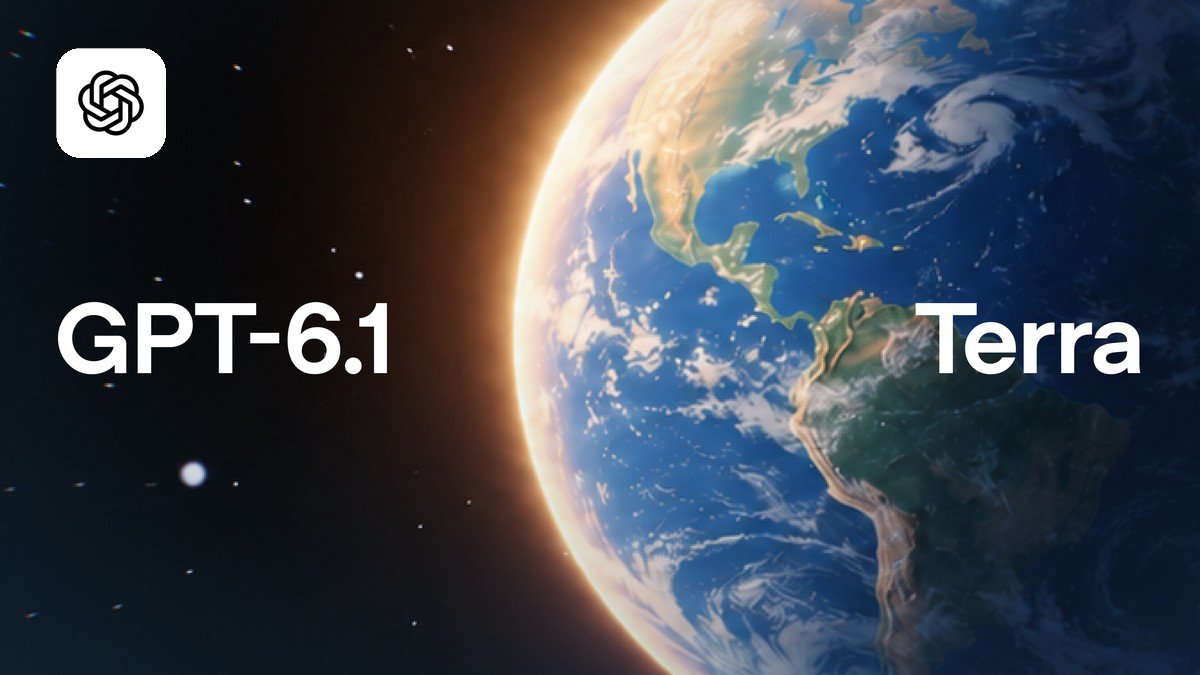
OpenAI has released GPT-6.1 Terra, a mid-sized model aimed at the work that fills a normal day: reading documents and screenshots, operating desktop apps, filling out forms and writing clearly. The headline for builders is price. Terra lists at $1 per million input tokens, $0.05 per million cached input tokens and $5 per million output tokens, which is half of what GPT-5.6 Terra and GPT-6.1 Sol cost. It is live in ChatGPT Work and Codex for Plus, Pro, Enterprise and Edu users, in the API as gpt-6.1-terra, and on Amazon Bedrock.
Key points
- API pricing is $1 input, $0.05 cached input and $5 output per million tokens, 50 percent below GPT-5.6 Terra and GPT-6.1 Sol.
- OpenAI says Terra scores 15 points higher than GPT-5.6 Terra on its Agents’ Last Exam computer-use benchmark at about one-third the cost, and finishes tasks over three times faster than GPT-6 Astra and GPT-6.1 Sol.
- Terminal-Bench 4.0 at max reasoning jumps to 50.3 percent, up from 21.5 percent for GPT-5.6 Terra. OpenAI still recommends Sol or Astra for the hardest coding work.
- On OpenAI’s internal hallucination test, the error rate at low reasoning effort fell from 53.6 percent to 16.7 percent.
- All benchmark numbers come from OpenAI. Independent results are only starting to arrive.
What shipped
Terra sits in the middle of OpenAI’s current lineup. An OpenAI employee on Hacker News laid out the ordering as Luna, then Terra, then Sol, then Astra, from smallest and cheapest to largest and most capable. Bigger models are generally more reliable and remember more obscure facts, but cost more per token.
The new Terra is pitched less as a smaller Sol and more as a specialist. OpenAI frames it around visual reasoning and computer use: reading technical drawings, turning them into 3D models, logging a film shot by shot, or pulling invoice details into accounting software. Bedrock lists a context window of up to 1 million input tokens with text and image input.
In ChatGPT Work and Codex, the practical change is usage. OpenAI says the same plan allowance covers more tasks with Terra than with GPT-5.6 Terra, and substantially more than with Sol or Astra.
What the benchmarks claim
- Agents’ Last Exam: at medium reasoning, 15 points above GPT-5.6 Terra at roughly a third of the cost, and on par with GPT-6 Astra at one-tenth its per-token price.
- Against Claude Opus 5.5: at max effort, OpenAI says Terra is over three times as token efficient and a quarter of the price per token, for about 9x lower cost per task.
- OSWorld 2.1: at medium reasoning, Terra beats GPT-5.6 Terra’s best score at a fraction of the cost per task.
- MMMU-Pro: better than GPT-5.6 Terra at every reasoning setting and close to Astra and Sol.
- Terminal-Bench-Science 0.1: ahead of GPT-6.1 Sol at lower cost and within five points of Opus 5.5 at under a fifth of the estimated cost.
These are vendor numbers on benchmarks OpenAI chose, several of them run at different reasoning efforts. Treat the cost-per-task comparisons as a reason to test, not as a result you can bank on. Early third-party tracking from AI Stupid Level has Terra slightly behind Claude Sonnet 5.5 on coding pass rate, 74 percent against 80 percent, but cheaper per correct answer because each attempt costs about half as much.
Where Terra fits against Claude
The obvious target is Anthropic’s Sonnet tier. The Decoder notes Claude Sonnet 5.5 lists at $2 input and $10 output, exactly double Terra. Claude Haiku 5.5 is cheaper on short prompts but its rates rise fivefold above 100,000 tokens, which agent workloads cross quickly. Terra’s flat pricing is easier to forecast for long-running agents.
The cached input price matters most here. At $0.05 per million tokens, a quarter of the old Terra rate, it lands on the part of the bill that dominates agent runs. As we covered in our look at the OpenAI and Anthropic price war, agents re-read the same context on every turn, so cache reads often make up the vast majority of tokens processed.
What it means for builders
- Re-test your mid-tier workloads. If you run document extraction, form filling, screenshot understanding or browser automation on Sol, Sonnet or GPT-5.6 Terra, Terra is worth a side-by-side run on your own data.
- Keep Sol or Astra for hard coding. OpenAI says so itself. Terra doubled its Terminal-Bench score, but complex multi-file engineering still belongs on the larger models.
- Model the bill on cache, not list price. For agents, compare cached input rates first. That is where Terra’s cut is steepest.
- Check reasoning effort. Many of the headline wins are at medium or max effort. Higher effort burns more tokens, so measure cost per finished task, not cost per token.
- Mind the security rating. OpenAI says Terra meets the Critical threshold for cybersecurity under its Preparedness Framework and ships with the same protections as GPT-6 Astra. Expect some refusals on security-adjacent tasks.
What to watch
The open question is whether independent benchmarks confirm the computer-use gains outside OpenAI’s own tests, and whether the factuality improvement holds on real documents rather than an internal prompt set. On pricing, the next move belongs to Anthropic: Sonnet 5.5 now costs twice as much as its most direct OpenAI rival. OpenAI is also reportedly bringing its top models to Google Cloud’s Model Garden, so Terra may show up on more clouds soon. For teams paying per token, mid-tier models just got cheaper again.