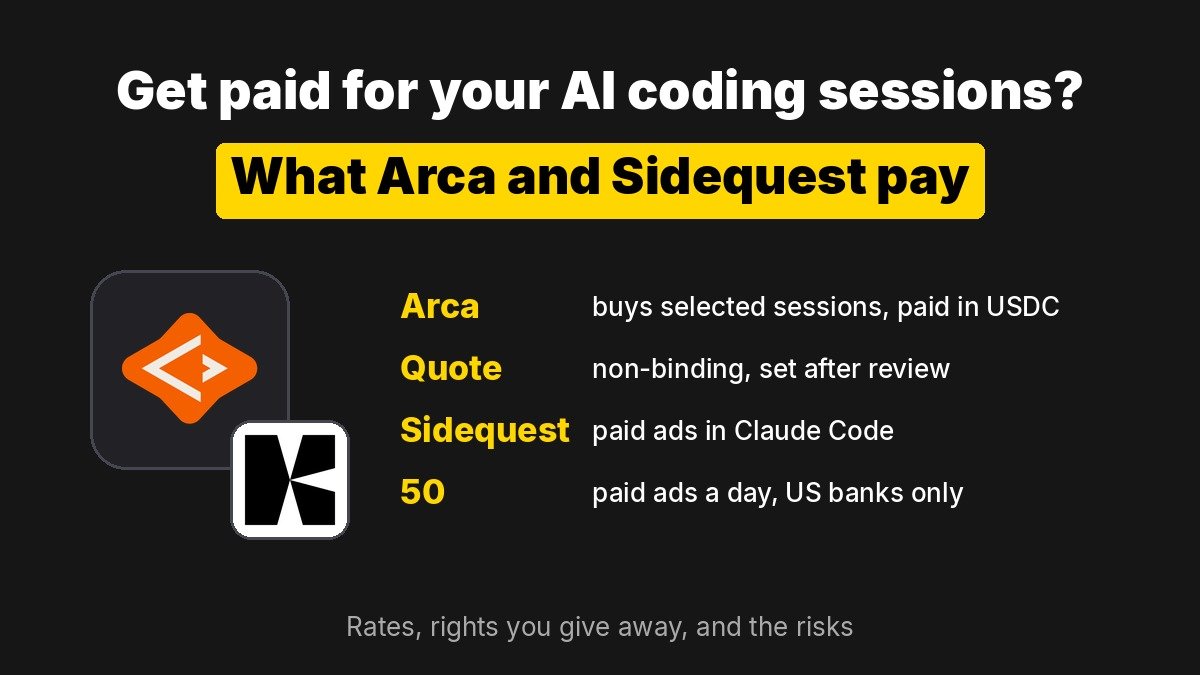
Short answer: Yes, two new apps now pay developers for the AI coding work they already do, but neither is meaningful income yet. Arca, from the team behind Brevis, opened to everyone and buys selected Claude Code, Codex, Cursor and Claude Desktop sessions as AI training data, with no published rates and payment in USDC. Sidequest, from Koah, pays you to see one sponsored line under each Claude Code answer, capped at 50 ads a day and limited for now to invited users with US bank accounts.
What launched this week?
Arca dropped its invite requirement and is now open to anyone on Mac and Windows. The desktop app finds the session history your AI tools already keep on your computer, lets you pick sessions to submit, strips details like names, file paths, account IDs and keys on your machine, then shows a quote range. You confirm or withdraw; approved sessions are paid weekly. Arca is also running a launch challenge with $10,000 in prizes on top of normal payouts.
A few days earlier, Koah let the first group into the Sidequest alpha. Sidequest is a mod for Claude Code in Claude Desktop and the terminal. After each Claude answer it shows one short text ad marked “Sponsored”, matched to what you are working on. Koah says Anthropic opened Claude Code to mods last month, and that more than 1,000 developers joined its waitlist the night it first posted the idea.
Both products target the same pain: heavy AI coding is expensive, and these apps promise to give some of that spend back. They do it in very different ways, and the difference matters more than the headline.
How do Arca and Sidequest compare?
| Arca | Sidequest | |
|---|---|---|
| What you give | Copies of selected AI sessions, plus optional repo or workspace snapshots | Your attention: one sponsored line under each Claude answer |
| Supported tools | Claude Code, Codex, Cursor cloud agent sessions, Claude Desktop and eligible Cowork sessions | Claude Code in Claude Desktop and the CLI; mobile, claude.ai and cloud sessions listed as coming soon |
| Published pay | None. Each upload gets a non-binding quote range; Arca sets the final amount after review | No published rate. The homepage demo shows +$0.01 beside an ad |
| Limits | Very short sessions do not qualify; every submission is reviewed | Up to 50 paid ads a day; manual review for the first month |
| Payout | USDC to a crypto wallet you connect, weekly | Stripe to a US bank account, from a $10 balance |
| Who can join | Anyone 18+ outside US-sanctioned countries; Mac and Windows, Linux coming | Invite-only from a waitlist |
| What they get | A perpetual license to use, train on and resell your data once paid | Ad views from developers, which advertisers pay for |
How much can you realistically earn?
Neither company publishes typical earnings, so anything beyond that is arithmetic, not a forecast.
Sidequest. If the $0.01 shown in the homepage demo is close to the real rate, the 50-ad daily cap puts the ceiling at about $0.50 a day. At that rate, reaching the $10 minimum payout would take around 20 full working days. That might cover a small slice of a subscription, not the subscription itself. Koah has said more ad formats are coming, so the rate could change in either direction.
Arca. Arca’s terms say the quote range “is not an offer, a guarantee, or a commitment to pay any amount”, and the final payment can land inside, above or below it. Arca says stronger sessions and a real track record earn more, and connecting GitHub can raise your rate. The only public signal of scale is the launch challenge leaderboard, which awards one point per $1 of approved payouts plus referral bonuses. When we checked, the leader had 13 points. That suggests early payouts are small or that few sessions had been approved yet; either way, there is no evidence of large sums so far.
| Question | Arca | Sidequest |
|---|---|---|
| Is the rate public? | No | No, only a demo figure |
| Is there a hard cap? | No stated cap | 50 ads a day |
| Rough ceiling we can calculate | Cannot be calculated | About $0.50 a day if the demo rate holds |
| Extra upside right now | Share of a $10,000 launch prize pool | None announced |
What are you actually giving away?
This is the part most launch coverage skips. Read the Arca terms of service before you upload anything.
- A permanent license. You keep ownership, but once a submission is paid, Arca holds a perpetual, irrevocable license to use it, train AI models on it, and license or sell the raw data and derived datasets to its customers. Before payment you can still request deletion; after payment you cannot.
- Your code, not just your chat. Arca describes its product as buying AI coding workflow data together with the associated private repository. Optional repo snapshots raise the value of a session and also raise what you expose.
- Promises you make. You warrant that the work is not employer or client code, contains no third-party confidential information, and that using your AI tools this way did not break the AI provider’s terms. If any of that turns out to be wrong, the risk sits with you.
- Anonymisation has limits. Stripping names, paths and keys does not remove business logic, architecture or product plans embedded in a long session. Arca’s own docs tell you to review what you submit.
Sidequest asks for much less: it shows ads matched to your session context and says it does not use cookies or third-party profiles. The trade-offs are an extra line of noise in your main work tool, payouts that need identity verification through Stripe, and a mod that reads enough of your session to match ads to it.
What does it cost, and what can go wrong?
- Employment contracts. Most developers’ day-job sessions belong to their employer or client. Selling them through Arca would breach Arca’s terms and very likely your contract. Only solo, personal or properly licensed open-source work is a candidate.
- Crypto payout risk. Arca pays in USDC to a wallet you control. Transactions are irreversible, you handle your own keys, and turning USDC into local currency may cost fees and carry tax obligations where you live.
- Country limits. Sidequest currently pays only to US bank accounts. Arca excludes people in US-sanctioned countries and may ask for identity, tax or sanctions checks before paying.
- Rejections and audits. Arca can reject any submission without detailed reasons and can act on paid submissions later if they turn out to break its terms. Fabricated or duplicate sessions are banned.
- Moving targets. Both products are days old. Rates, eligibility and supported tools will change, and early programs sometimes close.
How do you try it without regretting it?
- Sort your sessions first. Separate personal and open-source work from anything done for an employer or client. Only the first group is even eligible on Arca.
- Read the terms, not the landing page. The license and deletion rules in Arca’s terms decide what you are really selling.
- Upload one session and stop at the quote. The quote range costs nothing to see, and withdrawing deletes the upload. Use it to learn what your work is worth before confirming anything.
- Skip the repo snapshot unless the code is already public. A session without the repo exposes less.
- Join the Sidequest waitlist only if you can receive payouts. Right now that means a US bank account through Stripe.
- Track the real number. After a month, compare what you were paid with the time spent sorting and reviewing sessions. If it is pocket change, it is pocket change.
If you want earning power from AI coding skills rather than leftovers, client work is still the bigger market. We covered where that demand is growing in AI Freelance Work Grew 55% on Upwork.
Who is this a good fit for?
| Good fit | Poor fit |
|---|---|
| Solo builders with lots of personal Claude Code or Codex sessions | Anyone whose AI sessions are mostly employer or client work |
| Open-source maintainers comfortable with their work training AI models | People who want to keep their code out of training datasets |
| Developers already set up with a crypto wallet (Arca) | Anyone who needs predictable income |
| US-based Claude Code users who do not mind a sponsored line (Sidequest) | Developers outside the US hoping to use Sidequest today |
What should you watch next?
Watch whether Arca starts publishing typical payouts or rate bands, and how big the launch leaderboard gets by the end of the challenge; that will show whether AI labs value developer sessions enough to pay real money for them. For Sidequest, watch whether it opens beyond the invite list and US bank accounts, and how Anthropic treats ad-supported mods as the mod ecosystem grows. For now the honest read is simple: these apps can return a little of what you spend on AI coding, and the cost of the data option is a permanent license to your work.
Image credit: Arca