
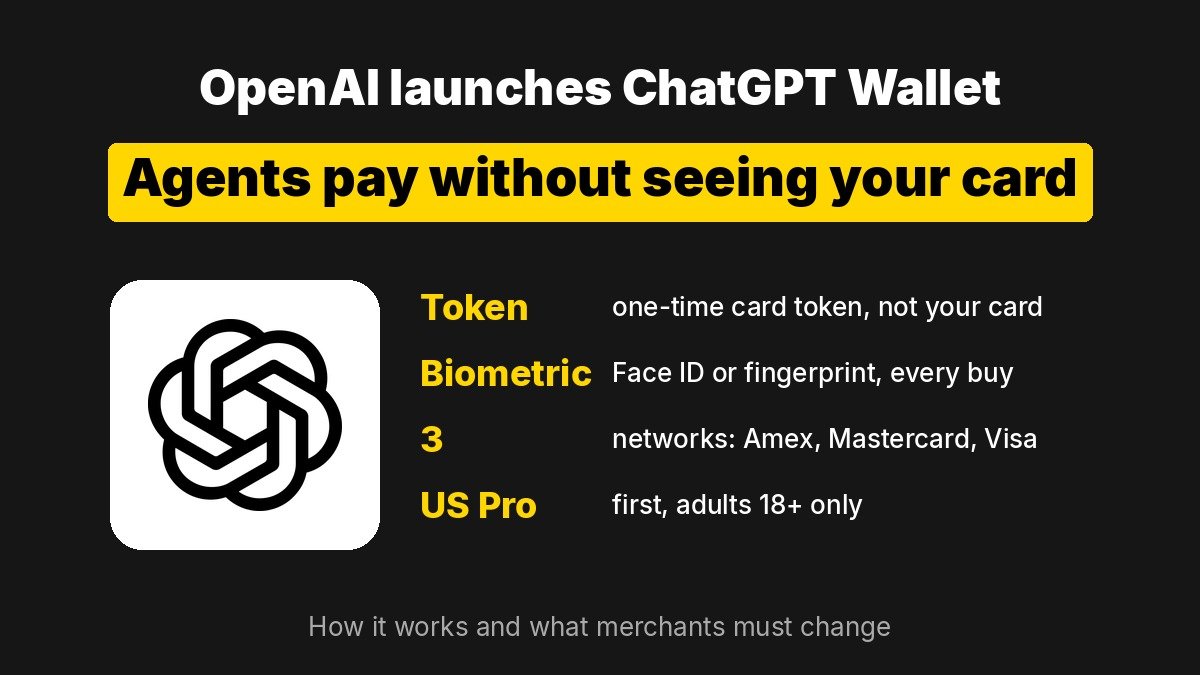
Short answer: OpenAI has launched ChatGPT Wallet, a way for its dots agents to pay for things on your behalf without ever seeing your real card number. You add a card once, approve every purchase with Face ID or a fingerprint, and the payment network hands the merchant a one-time token instead of your card details. It is rolling out first to ChatGPT Pro subscribers in the US, and for merchants it works with existing checkout pages, with no Wallet-specific integration required.
What did OpenAI launch?
According to OpenAI’s announcement, ChatGPT Wallet is a payment layer for dots, the personal agents OpenAI introduced at its developer conference in late September. A dot can already browse sites and fill carts. Wallet lets it finish the job and pay.
OpenAI built it with American Express, Mastercard and Visa. The Verge reports that eligible cards include US-issued American Express, Chase, Mastercard and Visa cards. OpenAI says your card keeps its existing rewards and its protections for eligible disputes, for example when an item arrives defective.
Access is narrow for now: ChatGPT Pro subscribers in the US, aged 18 or older, with an eligible US-issued card. OpenAI calls this limited availability on purpose, so it can learn from real use before widening the rollout.
How does a ChatGPT Wallet purchase work?
- Add a card once. You save a card in ChatGPT Wallet.
- Your dot shops. You ask your dot to find and buy something. It works through ChatGPT’s cloud browser on the merchant’s normal website.
- You approve every purchase. Before checkout you review the items, the total and the selected card, then confirm with a security check such as Face ID or a fingerprint scan. Each approval creates a record of what you authorized.
- The network issues a token. After approval, the payment network provides a substitute card number with its own security code and expiration date. The merchant charges that token, and the money comes from your real card.
The key design choice is that neither the agent nor the merchant ever holds your actual card details. OpenAI says that over time it expects to let users pre-approve purchases inside limits they set, such as spending caps, purchase categories or time windows. That is not available today. Every purchase still needs your approval.
How is this different from other ways agents pay?
Agent payments are arriving through several routes at once. Here is how Wallet compares with the two approaches builders run into most.
| ChatGPT Wallet | Agent types a saved card | x402 API payments | |
|---|---|---|---|
| What the agent sees | No real card details, only a one-time network token | The full card number | A funded stablecoin wallet |
| Human approval | Biometric check on every purchase | Depends on the setup | Usually pre-funded, no per-call approval |
| What the merchant needs | Its existing card checkout | Its existing card checkout | An x402-enabled endpoint |
| Best fit | Consumer shopping on normal websites | Nothing you should rely on | Machine-to-machine API calls |
x402 is built for agents paying APIs per request in stablecoins. Wallet sits at the opposite end of the market: big card networks, consumer purchases and the checkout pages that already exist.
What do merchants and developers need to do?
OpenAI’s accept payments guide says Wallet works out of the box with existing checkout pages and payment forms. The real risk is not the payment itself. It is your own bot defenses rejecting a legitimate agent. OpenAI’s Commerce Partner Playbook lists what to check:
- Let verified agent traffic through. The cloud browser signs its requests with Web Bot Auth. Akamai, Cloudflare, HUMAN and Vercel verify those signatures automatically, and Cloudflare shows the traffic as “dots, OpenAI” under Personal Agents. On other stacks, OpenAI’s agent access guide says to confirm the
Signature-Agentheader exactly matches"https://chatgpt.com"and verify the signature against the public key directory atchatgpt.com/.well-known/http-message-signatures-directory. We fetched that directory and it currently returns a single Ed25519 key. - Tune fraud rules. Risk systems that rely on IP addresses and browser fingerprints can block agent purchases by accident. OpenAI is rolling out a
Forwardedheader that relays the user’s signals, such as country, network prefix, locale, time zone and user agent. If you use a risk provider, ask whether it reads this header. OpenAI says it is working with Forter, Riskified, Sardine and Signifyd, plus payment providers Adyen, Checkout.com and Stripe. - Treat the token as single use. You receive a network token, not the full card number, and you link it to the underlying account through the Payment Account Reference (PAR). The customer consents to one transaction only, so do not save or reuse the credential. Subscriptions are fine if your checkout already supports recurring billing and you collect consent.
- Keep product data current. Claim your business in ChatGPT and upload a product feed with live pricing and availability so agents find accurate offers.
- Build a plugin only if it pays off. A headless MCP plugin lets agents check stock or manage carts directly. OpenAI notes that iframe-based MCP UI is not supported in dots, and that plugins and Wallet do not yet work together at checkout.
Does OpenAI take a cut of Wallet purchases?
Not yet. OpenAI told CNBC it is not taking a cut of transactions to start. The near-term goal is to win over merchants and payment partners. Commerce could still become a revenue stream later, and OpenAI points to more than 1.2 billion weekly ChatGPT users as the audience it eventually wants to bring to checkout.
This is also not OpenAI’s first try at shopping. CNBC notes it pivoted away from an earlier Instant Checkout feature and later relaunched shopping around product discovery. Wallet builds on that discovery work instead of replacing it.
What are the limits and open questions?
- Merchants can still say no. CNBC reports that United Airlines plans to block agents from booking on its systems, and Amazon prevents agents from buying on its platform. A wallet does not help if the store blocks the agent at the door.
- Fraud declines are the weak point. The token travels through normal checkout, but the risk engine in front of it may still reject the order until providers adapt.
- Availability is small. Pro only, US only, eligible US cards only. Most ChatGPT users cannot try it yet.
- Full delegation is a promise, not a feature. Spending limits and pre-approved categories are described as a future direction.
What should you watch next?
Watch whether more large retailers allow verified agent traffic or follow Amazon and United in blocking it, whether risk providers ship support for the new Forwarded signals, and when Wallet expands beyond Pro and the US. If you run an online store, the cheapest move today is to check your CDN and fraud settings against OpenAI’s playbook so legitimate agent orders do not fail silently.
Key takeaways
- ChatGPT Wallet lets OpenAI’s dots agents pay for purchases using a one-time network token, so the agent and merchant never see your real card.
- Every purchase needs your biometric approval. Pre-approved spending limits are planned but not live.
- It starts with US ChatGPT Pro subscribers aged 18 and older, built with American Express, Mastercard and Visa.
- Merchants need no Wallet integration, but bot protection and fraud rules may need tuning for Web Bot Auth and the new
Forwardedheader. - OpenAI is not taking a transaction cut for now, and big merchants like Amazon still block agents.
Image credit: OpenAI