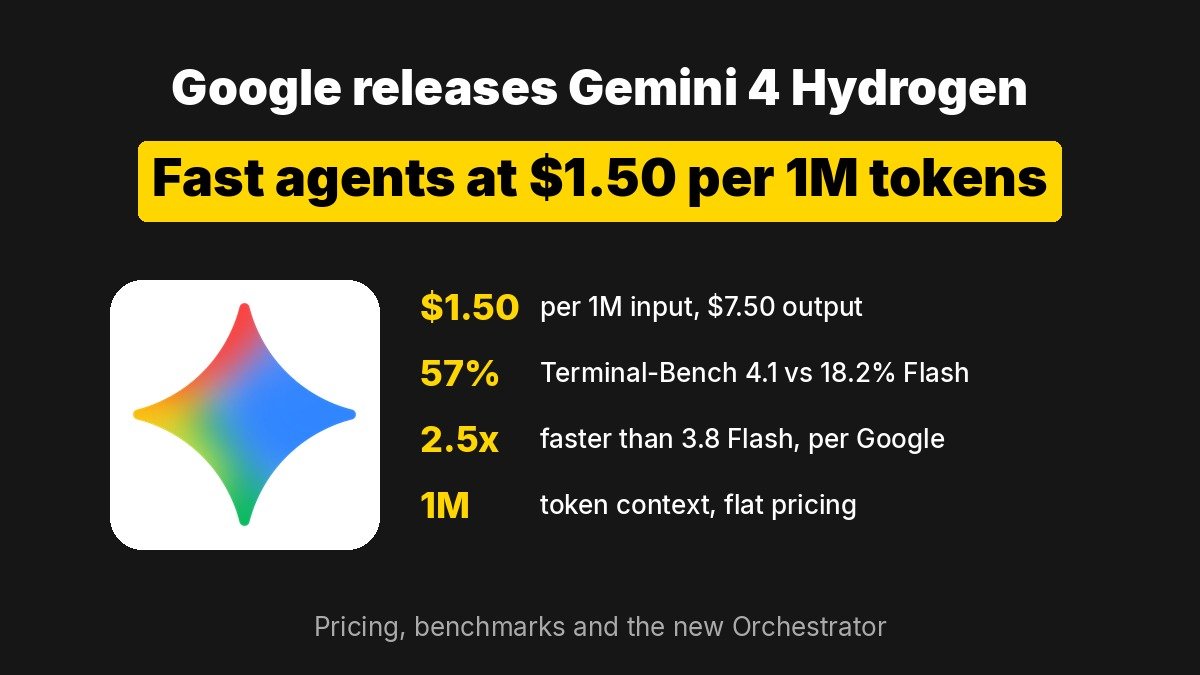
Short answer: Google has released Gemini 4 Hydrogen, a fast execution model in the Gemini 4 family built for everyday coding and agent work. Google says it scores 51 on the Artificial Analysis Intelligence Index at its default setting (above Gemini 4 Argon’s 50), hits 57% on Terminal-Bench 4.1 versus 18.2% for Gemini 3.8 Flash, and costs a flat $1.50 per million input tokens and $7.50 per million output tokens across its full 1 million-token context. It is live now in the Gemini API, AI Studio, the Gemini app, Google Search and, for paid plans, Google Antigravity.
What did Google ship?
According to Google’s announcement, Hydrogen sits below the two frontier models, Gemini 4 Carbon and Gemini 4 Argon. Those handle deep, long-horizon reasoning. Hydrogen is pitched as the model that does the work: writing code, running tests, calling tools and verifying changes, quickly and cheaply.
Two things launched together:
- Gemini 4 Hydrogen, available across the Gemini API, Google AI Studio, Android Studio, Gemini for business, the Gemini app, Google Search and Gemini in Google Sheets.
- Orchestrator, a new option in the Google Antigravity model picker that switches between Carbon (or Argon) and Hydrogen inside a single session.
How much does Gemini 4 Hydrogen cost?
Google lists one flat price across the whole 1 million-token context window: $1.50 per million input tokens and $7.50 per million output tokens. Flat pricing matters if you feed it large repositories or long documents, because many models charge more once a prompt crosses a long-context threshold.
The model has four thinking levels: low, medium, high (the default) and a new xhigh tier. Higher levels spend more output tokens on reasoning, so the real cost of a task depends on which level you pick. Free Gemini app users only get Hydrogen when auto model selection decides it fits the prompt.
How does Hydrogen compare with Gemini 3.8 Flash?
Google positions Hydrogen as the upgrade path for teams on 3.8 Flash. These are Google’s own numbers, not independent tests:
| Metric (Google-reported) | Gemini 4 Hydrogen | Comparison |
|---|---|---|
| Artificial Analysis Intelligence Index | 51 (high), 54 (xhigh) | Gemini 4 Argon: 50 |
| Terminal-Bench 4.1 | 57% | Gemini 3.8 Flash: 18.2% |
| Task speed at default setting | 2.5x faster | vs Gemini 3.8 Flash |
| Fabricated claims | More than 5x fewer | vs Gemini 3.8 Flash |
| Partner workloads (graphs, SQL, data-heavy) | 2x to 2.8x faster, 12% to 23% fewer tokens | vs Gemini 3.8 Flash |
| HLE-Diamond | 58.8% | Leads its class, per Google |
| Agent Arena (arena.ai) | Ranked #5 | Live leaderboard |
Google also claims Hydrogen makes focused edits without rewriting unrelated files, batches file reads and searches in parallel, and recovers when a tool call fails or a search comes back empty. Those are the behaviors that decide whether a coding agent is usable day to day, so they are worth testing on your own repo before believing them.
What is Orchestrator in Google Antigravity?
Orchestrator is Google’s answer to the cost of running a frontier model on every step. Instead of a static router that guesses difficulty from your first prompt and sends the whole task to one model, Orchestrator hands work back and forth during the session. In Google’s example, Carbon explores the codebase in a read-only phase and writes a plan, Hydrogen takes over to make edits and run tests, and if Hydrogen gets stuck it hands back to Carbon to repair the plan.
Google says Orchestrator reached near-Carbon task success while using 24% less quota and finishing 19% faster on average. One detail to note: the main announcement cites Terminal-Bench 4.0 for that result while the Antigravity post cites Terminal-Bench 4.1, so treat the exact benchmark as unclear until Google clarifies.
Access is tiered. Google AI Ultra subscribers get Orchestrator (Carbon) and Orchestrator (Argon). Paid Google AI Pro subscribers get Orchestrator (Argon) only. Developers who want explicit control can wire Hydrogen and Carbon into separate roles with the Antigravity SDK, for example Hydrogen agents for triage and quick fixes and a Carbon agent for refactors and security checks.
Is Gemini 4 Hydrogen safer for agent work?
Google reports that, compared with 3.8 Flash, Hydrogen reduces overreach in agentic tasks by up to 81%, cuts misaligned actions and task shortcutting by 12x, is up to 2x less likely to bypass permission boundaries on blocked tasks, and is more than 2.3x more resilient on the Gray Swan indirect prompt injection benchmark. It also reports a 96.7% honesty rate on an internal agent honesty evaluation. Most of these are internal evaluations, so the model card is the place to check methods.
What does this mean for builders?
- Cheaper agent loops. If you run coding or research agents on a frontier model, Hydrogen is a candidate for the worker and verifier roles, with a bigger model kept for planning.
- Flash migrations need retesting. Faster and smarter also means different behavior. Rerun your evals and watch output token counts at each thinking level, since that is where cost moves.
- Long context without a price jump. Flat pricing to 1 million tokens makes whole-repo and large-document jobs easier to budget.
- Search is changing too. Hydrogen now powers Google Search responses with a wider query fan-out, which Google says links to a broader range of sites. Publishers should watch referral traffic over the next few weeks.
What should you watch next?
Independent results are the next test. Watch for third-party runs on Terminal-Bench and SWE-style benchmarks, real pricing comparisons against competing fast models, and whether Orchestrator reaches Pro users with Carbon. Until then, the safest move is a side-by-side run of Hydrogen against your current model on a week of real tasks.
Key takeaways
- Gemini 4 Hydrogen is Google’s fast execution model for coding and agents, live across the API, AI Studio, the Gemini app and Search.
- It costs a flat $1.50 per million input tokens and $7.50 per million output tokens across 1 million tokens of context.
- Google reports 57% on Terminal-Bench 4.1 versus 18.2% for 3.8 Flash and a 51 to 54 Intelligence Index score.
- Orchestrator in Antigravity mixes Carbon and Hydrogen in one session, with Google claiming 24% less quota and 19% faster runs.
- All numbers are Google-reported. Test it on your own workload before switching.
Image credit: Google