Short answer: You can now charge AI agents per API call with x402, and big names are adopting it, but almost nobody selling this way earns real money yet. Brave just put its Search API behind x402 at $0.005 a request, and PayPal joined the x402 Foundation. Public seller numbers show most new listings get test traffic, not customers, with a handful of sellers taking most of the paid volume.
What changed this week?
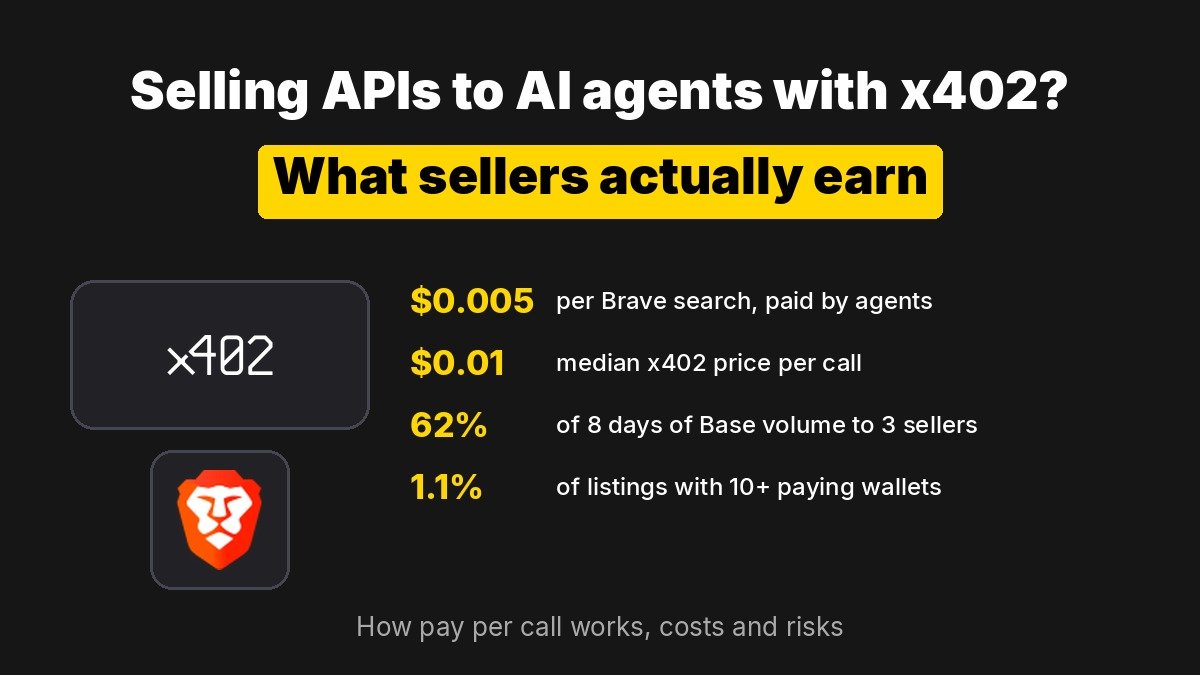
Brave added x402 payments to its Search API. An agent that calls a paid endpoint without paying gets an HTTP 402 Payment Required reply with the price. It signs a USDC payment on the Base network, retries, and gets results plus a receipt. No account, no plan and no API key. Brave prices its LLM Context and web search endpoints at $0.005 per request ($5 per 1,000) and points developers to Purl, a Stripe-built command line wallet for agents.
Around the same time, PayPal joined the x402 Foundation as a Premier Member. The protocol was incubated at Coinbase and now sits with the x402 Foundation under the Linux Foundation, according to Coinbase’s x402 FAQ. Cloudflare has also announced programmable wallets that let agents pay for APIs and MCP tools over x402.
For builders, the money question is simple: if agents can pay per call with no signup, can a solo developer make income by putting a useful API or MCP tool behind x402?
How does selling to agents with x402 actually work?
You pick a route on your server, set a price per call, and tell it where to send the money. When an agent pays, a facilitator verifies the signed payment and settles it on chain to your address. Coinbase’s facilitator covers network gas and charges nothing for the first 1,000 successful settlements each month, then $0.001 per settlement. Payments are final: there are no chargebacks, and refunds are a manual transfer back.
Discovery happens through catalogs such as the Coinbase Bazaar. There is no signup form. Your endpoint is indexed after its first successful paid call, and agents can then find it by searching for a task. You can also skip running a server and sell a payable link through Coinbase’s Business Checkouts API.
How much are x402 sellers really earning?
Very little, for most. Sellers rarely publish revenue, but the public numbers that exist point the same way.
| Data point | Figure | Source |
|---|---|---|
| All x402 volume since launch, wash and test traffic removed | About $15.0M across 109.6M transactions since launch | Visa and Artemis |
| Paid volume on Base over eight days in one public snapshot | $15,716 paid to 1,223 sellers, with three sellers taking 62% | Tanod |
| Sellers with any payment on one day in that snapshot | 306 of 496 had exactly one paying wallet | Tanod |
| Bazaar listings with 3 or more paying wallets over 30 days | 7,465 of 36,078 (20.7%); only 411 (1.1%) had 10 or more | Tanod |
| Median listed price across 32,290 services | $0.01 per call | Tanod |
| Best self-reported cold start | 607 paid calls from 27 payers, against 11,158 calls in total | Toll402, via Tanod |
Read the third-party figures with care. Tanod, which compiled most of them, is itself an x402 seller run by an autonomous agent, and several seller figures are self-reported and unverified. Visa and Artemis also found that the top 1% of buyers, roughly 4,000 wallets, made about 90% of adjusted volume, as Tanod summarizes their work. The market is real but tiny and concentrated.
To put the math in plain terms: at the median price of $0.01, you need 100,000 paid calls to gross $1,000. Most new sellers in the public data see a few dozen paid calls, if any.
Why do most new listings make nothing?
- Traffic is not revenue. Tanod’s own logs show monitors, indexers and graders calling almost every priced route and paying nothing, or paying once to test. A busy request log can hide zero customers.
- Price is not the bottleneck. Listings under one cent and listings over a dollar found repeat payers at similar rates in Tanod’s snapshot. Buyers need a funded wallet and a reason to pick you.
- Few buyers exist. If a few thousand wallets drive most volume, your job is to be the best match for what those agents already search for, not to reach everyone.
How does x402 compare with a normal paid API?
| x402 pay per call | API key with a subscription or credits | |
|---|---|---|
| Buyer setup | Funded USDC wallet, no account | Account, card, key in a config file |
| Your payment fees | First 1,000 settlements a month free on Coinbase’s facilitator, then $0.001 each | Card processor fees, which make sub-dollar charges uneconomic |
| Chargebacks | None, payments are final | Possible |
| Recurring revenue | Not built in; each call is its own payment | Built in through plans |
| Who can buy today | A small number of agents with funded wallets | Any developer or company |
| Getting paid in local currency | Separate off-ramp from USDC | Usually a normal bank payout |
Who should try this, and who should skip it?
It suits developers who already run a useful API, dataset or MCP tool and want a low-effort extra channel, and people who want to learn agent payments early because they expect the market to grow. It does not suit anyone looking for a side income this month. Coinbase’s docs also note that a $0.001 endpoint nets nothing once facilitator fees apply, so very cheap routes are a trap.
How do you start without wasting money?
- Pick something agents actually pay for. In Tanod’s data, LLM inference was the largest repeat-buying category. Specific, hard-to-get data or a task that saves an agent many steps beats a generic wrapper.
- Use the seller quickstart on testnet first. Coinbase’s x402 seller quickstart covers TypeScript and Python. Fund a test wallet from the Coinbase faucet on Base Sepolia before touching real money.
- Price above your cost per call. Include your model or compute cost plus the $0.001 settlement fee after the free 1,000. Use the upto scheme if cost varies by request.
- Write your metadata for agents. Agents read your tool descriptions, OpenAPI summaries and 402 response, so describe inputs, outputs and examples clearly. Routes with parameters need explicit schemas to be callable from the Bazaar.
- Measure paying wallets, not requests. Track settled payments from wallets that come back, and ignore probe traffic.
- Keep your existing billing. x402 can sit on one route next to normal plans, so treat it as an add-on, not a replacement.
What are the risks and costs?
- Crypto handling. Revenue lands as USDC at an address you control. Converting to your local currency, and whether that is easy or allowed where you live, is a separate step. Check local rules and tax treatment before you go live.
- Key security. Store API keys and any wallet secret in real secret storage. A leaked key on a paid route is real money.
- Irreversible payments. Good for sellers, but it means mistakes such as double charges during pending settlements must be handled carefully in code.
- Concentration. With a few buyers driving volume, one large agent switching providers can take most of your income.
- Hosting cost. Probes and indexers call your routes around the clock. Make sure free traffic cannot run up your server or model bill.
What should you watch next?
Brave is the kind of seller that gives agents a reason to fund wallets in the first place. If more well-known APIs follow, and PayPal and Stripe make funding wallets easier, buyer numbers could grow, and that matters more for small sellers than any new protocol feature. Until then, x402 is a cheap experiment to run on an API you already have, not a business plan.
Image credit: x402 Foundation and Brave