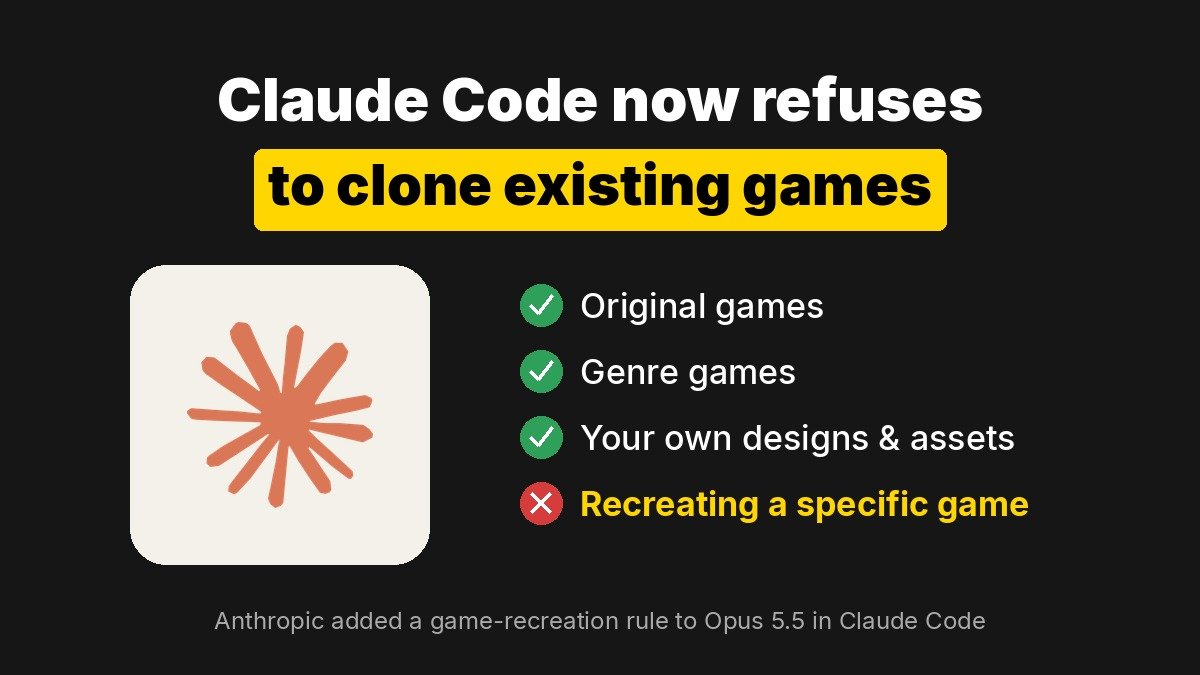
Anthropic has added a rule to Claude Code that tells Claude not to build a recreation of a specific existing game, even if the copy is renamed or called “original.” Original games, genre games and games built from your own designs and assets are meant to keep working, and early testing suggests decompilation and porting work is not banned outright. The catch is that developers are reporting refusals on legitimate projects, so anyone who uses Claude for game, modding or reverse-engineering work should expect some friction and keep a fallback.
Key points
- The rule reads: “Do build original games, games in a genre, and games from the user’s own designs and assets. Don’t build a recreation of a specific existing game, even if it is renamed or called original.”
- Anthropic’s Addy Osmani confirmed the company “added two sentences to Claude Code’s prompt on Opus 5.5” because using Claude to infringe IP breaks its usage policy, and asked developers to report wrongful refusals.
- XDA Developers found the text inside the Claude Code binary and says it can reach Opus 5.5 on its own or apply to every model in Claude Code through a remote config flag.
- In XDA’s tests, Opus 5.5 still offered to help with a decompilation project and a static recompilation. Separate user reports describe refusals on board-game modules, anti-cheat work and general reverse-engineering, which Anthropic has not explained.
- There is no switch to turn the rule off.
What did Anthropic change in Claude Code?
The change was first spotted by X user Chasm, who found a new instruction delivered to Claude Code through a server-side configuration field called tengu_heron_brook. That field is not game-specific. XDA Developers says Anthropic has used it before to push adjustable instructions remotely, including an unrelated one about reasoning effort. In other words, it is a lever Anthropic can pull without shipping a new release.
XDA also confirmed the exact rule text sits inside Claude Code version 2.1.314, alongside a second path labeled original_games_guidance in an Opus 5.5 prompt bundle. Its reading: Opus 5.5 can get the game rule by default, while accounts that receive it through the remote flag get it on every model they use in Claude Code.
When Game Developer asked for comment, an Anthropic spokesperson pointed to a post from Osmani, a member of Anthropic’s technical staff: “We added two sentences to Claude Code’s prompt on Opus 5.5 to steer it away from recreating someone else’s specific game because using Claude to infringe IP is against our usage policy. Original games, genre games, and games built from your own designs and assets are meant to keep working.” He added that anyone whose own project gets turned down should send it his way.
Why is Anthropic doing this now?
The trigger is a wave of AI-built game clones. Indie studios have been canceling public playtests out of fear that someone will feed a demo into an AI coding agent and ship a copy first, and Tom’s Hardware reports some developers have been threatened with exactly that unless they pay. Steam’s showcase events have also been flooded with lookalike titles, and Valve has faced pressure from developers to explain how it will keep clones from crowding out the originals.
Anthropic’s Usage Policy already bans using Claude to infringe intellectual property. The new prompt text turns that policy into a specific instruction the model sees in every relevant session, rather than leaving it to the model’s general judgment. There is also a legal motive: an AI company that makes cloning a hit game trivial is an obvious target for the next lawsuit.
What does the rule block, and what still works?
The written rule is narrow. How the model applies it is less predictable. Here is what is confirmed, what testing suggests and what is still only reported.
| Task | Status | Basis |
|---|---|---|
| Building an original game | Allowed | Rule text and Anthropic’s statement |
| A game in an existing genre (a roguelike, a platformer, a farming sim) | Allowed | Rule text and Anthropic’s statement |
| A game from your own designs and assets | Allowed | Rule text and Anthropic’s statement |
| Recreating a specific existing game, even renamed | Blocked | Rule text, confirmed by Anthropic |
| Decompiling a game you own into readable C | Worked in testing | XDA tests on Opus 5.5 |
| Static recompilation so an old game runs natively on PC | Worked in testing | XDA tests on Opus 5.5 |
| Copying a specific mechanic, or digital modules for physical board games | Some refusals reported | User reports on Claude Code’s GitHub, not reproduced by XDA |
| General reverse-engineering (crash dumps, TV firmware, anti-cheat reviews) | Some refusals reported | User reports via Tom’s Hardware, likely a separate cyber safeguard |
The last row probably has a different cause. Anthropic’s generally available models ship with what it calls conservative cyber safeguards that block most cyber work, and Anthropic points security teams to its Cyber Verification Program for reduced blocking. A crash-dump or firmware refusal is more likely that classifier firing than the game rule. For the person staring at the refusal, the effect is the same.
Why are legitimate developers getting caught?
Because Claude cannot verify ownership. The model has no way to check whether you hold the rights to a game, whether the assets you uploaded are yours or whether a “personal remake” will stay personal. It can only read the request and guess.
That leads to the cases developers are complaining about. One developer filed an issue reporting that Opus 5.5 stopped helping with digital board-wargame modules built from materials supplied by customers who owned the physical games. Others describe refusals partway through a project, after the code had already drifted toward a known title. And a commenter on Tom’s Hardware made a fair point: plenty of original games start as “game X, but with Y,” then grow into something new. A literal reading of the rule could stop that on day one.
XDA’s tests also showed how much framing matters. Asked to recreate a well-known handheld game, both Opus 5.5 and Opus 5 refused. Asked to help decompile the same game from a user’s own copy, Opus 5.5 agreed and offered to build tooling for the project. The same codebase can land on either side of the line depending on how the task is described.
What should you do if Claude refuses your game project?
- Describe your work accurately. Say whether you are building an original game, using your own assets or working from a copy you own. The rule names those cases as allowed, so state them plainly. Do not misrepresent a clone. That breaks the usage policy and can get an account flagged.
- Reference mechanics, not titles. “A deck-building combat system with energy costs” gets you further than “make it like a specific hit game,” and it produces a more original design anyway.
- Start a fresh session after a refusal. Several developers report that a session which has refused once keeps refusing. A clean context with a clearer brief often goes through.
- Report wrongful refusals. Anthropic has asked for them directly, and the Claude Code GitHub issues are where patterns get noticed.
- Apply for cyber access if security is your job. If the refusals hit malware analysis, anti-cheat or vulnerability work, the Cyber Verification Program is the sanctioned route to lighter safeguards.
- Keep a second model ready. OpenAI’s Codex, which runs models like GPT-6.1 Sol, and open-weight models are not bound by this rule. Even if you stay on Claude, a fallback keeps a deadline from depending on one vendor’s prompt changes.
What does this mean for builders beyond games?
The bigger story is the mechanism, not the games. Anthropic changed what Claude Code will do by pushing a couple of sentences from its servers, with no release note, and users found out from refusals and a binary teardown. It is the same pattern developers have been describing with Claude’s training-related and cyber safeguards: rules that tighten quietly, show up as interrupted sessions and get explained after the fact, if at all.
None of that makes the rule itself unreasonable. Cloning someone else’s game is exactly the kind of use a model vendor should refuse. But if your product or workflow depends on an AI coding agent, its behavior is now something the vendor can change remotely at any time. Treat it like any other dependency: pin what you can, watch the changelog and the issue tracker, and test the tasks that matter to you after each update.
What to watch
- An official Anthropic post or release note that spells out the rule, its scope and which models get it.
- Whether the rule spreads from Opus 5.5 to every model in Claude Code, and to the Claude apps and API.
- Fixes for false refusals on board-game, mod and decompilation work that Anthropic says should be allowed.
- Whether OpenAI, Google and other coding-agent vendors add similar game or IP rules.
- How Valve and other storefronts handle AI-built clones that come from tools without these rules.
Sources
- Game Developer: Anthropic orders AI tool Claude to stop remaking video games (with Anthropic’s confirmation)
- XDA Developers: Anthropic seems to be testing a crackdown on vibe-coded ports of existing games
- Tom’s Hardware: Claude blocks video game cloning, users report wider reverse-engineering refusals
- Anthropic: Usage Policy
- Anthropic: Expanding the Cyber Verification Program
- Hacker News discussion