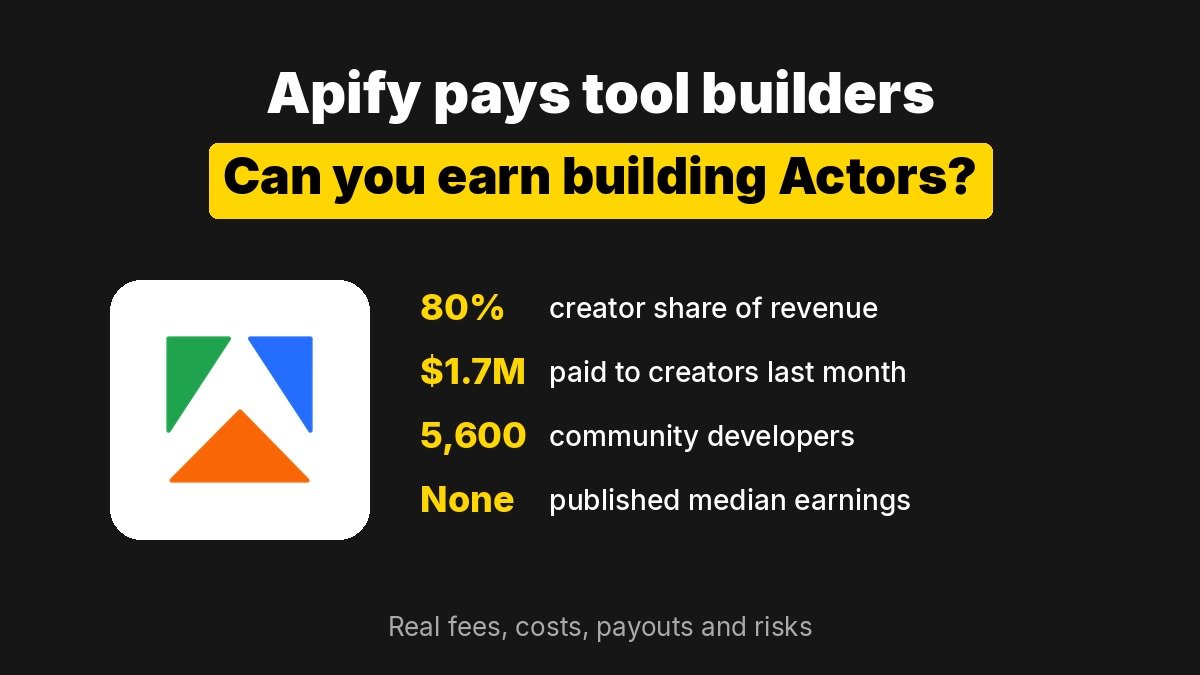
Short answer: Yes, developers are earning real money building tools on Apify Store, and it is one of the few AI-agent tool marketplaces that publishes its payouts: about $1.7 million paid to creators last month, with Apify’s CEO saying creator earnings are approaching $2 million a month. Creators keep 80% of revenue minus the cost of running their tools, but that money is spread across roughly 5,600 community developers and very unevenly, so most new tools will earn little or nothing at first. It suits developers who can build one reliable scraper or data tool for a job that people, and increasingly AI agents, already pay for.
What is Apify saying creators earn?
Apify is a platform for web scraping and automation tools called Actors. Anyone can publish an Actor to Apify Store and charge for it. In an interview with ShiftMag ahead of the company’s Run by Apify conference in San Francisco, CEO Jan Čurn said: “we pay 80% of the revenue to the creators. These creators are making about $2m per month,” adding that the figure is growing “maybe four to five times year over year.” He also said a single developer “could earn several thousand dollars per month” from a tool on the platform.
Apify’s own developer page is slightly more conservative. It lists $1.7 million paid out last month, 5,600 community developers and more than 115,000 tools and automations in the Store. The pitch has also shifted toward AI. Čurn told ShiftMag that agents are becoming the customer: “People are no longer selecting the tools themselves, but they have their agents do it on their behalf.” Apify now lets AI agents connect through its MCP server and, in an experimental feature, pay for runs themselves.
How much can a typical developer realistically earn?
Apify does not publish a median or typical creator income, so nobody outside the company can say what a normal Actor earns. What we can do is the rough maths. $1.7 million divided across 5,600 developers is about $300 per developer per month on average. Marketplace income is almost always top-heavy, so the median is very likely well below that, and a small group of popular tools probably earns most of it. Treat “several thousand dollars per month” as a ceiling some creators reach, not an expectation.
Apify’s pricing documentation gives a worked example that shows how the money flows. A social media monitoring Actor charges $0.002 per post scraped and $0.01 per post analysed with an LLM. Two paying users generate $31 of charges and $4 of platform costs, so the creator’s profit is 0.8 × $31 − $4 = $20.80. A third user on Apify’s free plan also runs it, but free-plan usage does not count toward revenue. Apify covers that user’s platform costs instead.
| Item | What Apify’s docs say |
|---|---|
| Your share | 80% of revenue; Apify keeps 20% and charges nothing if the Actor earns nothing |
| Running costs | Deducted from your payout on pay-per-event Actors, for example $0.20 per compute unit and $8 per GB of residential proxy traffic on the standard tiers |
| Free-plan users | Bring no revenue; Apify covers their platform costs |
| Losing Actors | If an Actor’s costs exceed its revenue for a month, its profit is set to $0 so it does not cut into your other Actors’ payouts |
| Minimum payout | $20 via PayPal or Wise, $100 for other methods; smaller balances roll over |
| Payout schedule | Monthly: invoice on the 11th, payment between the 21st and 25th |
| Testing budget | The Creator plan includes $500 of prepaid usage for the first six months |
How does pay-per-event pricing work?
Apify has retired its old fixed monthly rental pricing and moved paid Actors to pay-per-event. You define the events your code charges for, such as an Actor start, a result saved to the dataset, a profile scraped or an LLM call, and set a price for each. Users only pay for what they actually run, which Apify says suits AI agents that cannot manage dozens of monthly subscriptions.
The catch is that you now carry the risk of your own costs. If your price per result is lower than the compute and proxy cost of producing it, your Actor loses money on every run. The docs suggest pricing slightly above break-even at first and adjusting, and allow you to pass platform costs on to users while you learn. Apify’s pricing tips also recommend checking competing Actors in the Store before you set a price.
Can AI agents really pay for your tool?
Partly, and it is early. Apify’s agentic payments let an AI agent buy a prepaid, spend-capped Apify token without a human creating an account. The agent pays through x402 or MPP using stablecoins, or through Skyfire, with a $1 minimum. The token expires after 14 days and unused balance is not refunded. Any Actor that uses limited permissions can be run this way, whatever its pricing model, with no separate opt-in.
For creators, that means an agent can discover and pay for your Actor in the same way a person would. Apify labels the feature experimental, and it does not say how much revenue comes through agent payments today. The more established route for agent traffic is still a person or company connecting Apify to their agent with a normal paid account.
How does Apify compare with other ways to earn from automation?
| Platform | What you sell | Platform cut | Who pays for compute | Published creator earnings? |
|---|---|---|---|---|
| Apify Store | Scrapers, data tools, automations and agents (Actors) | 20% | You, deducted from payout (except free-plan users) | Yes, in aggregate: $1.7M last month across about 5,600 developers |
| NEAR AI Agent Market | An agent hired per job | 5% per completed job | You | No |
| Moltify | A specialist agent per task | 12%, minimum $0.50 per task | You | No |
| Gravity | An Activepieces automation | You receive about 21% to 25% of each run | Gravity | No |
Apify takes a bigger cut than the newer agent stores, but it has something they do not yet have: years of existing buyers and a public payout number. The newer stores charge less, but none of them shows that builders are being paid at any scale.
What does it cost, and what can go wrong?
- Running costs on every paid run. Compute, proxies and data transfer come out of your 80%. Residential proxies are the expensive part for scrapers that need them, so test your real cost per 1,000 results before setting a price.
- Maintenance never stops. Apify tests every public Actor daily with its default input. If more than half of the test runs over three days fail, your Actor is labelled Under maintenance, and if it keeps failing for about a month it is marked Deprecated. Websites change their layouts and anti-bot systems often, so scrapers break.
- Compensation deductions. When a run fails or returns bad data, users can ask for compensation. If it is approved, the amount is deducted from your payout.
- Payout friction. You must pass identity verification before you are paid. Bank payouts go by SWIFT from the Czech Republic, and Apify warns that intermediary fees typically run $10 to $50 per transfer. PayPal or Wise is usually cheaper if it works in your country.
- Legal and ethical limits. Scraping personal data or ignoring a site’s terms can create legal risk for you and your users. Read Apify’s acceptable use policy and avoid tools built around collecting personal information.
- Crowded categories. With more than 115,000 Actors listed, popular jobs such as Google Maps, Instagram and Amazon scraping already have many competitors. Čurn himself describes discovery as the hard part: “If there are 50 tools, or maybe 500, or 5,000, which one are you going to pick?”
How do you publish your first paid Actor?
- Find a gap, not a crowded category. Search the Store for the job you want to automate. Look for niches with few Actors, weak ratings or open issues, such as a regional property site, a specific job board or an industry directory.
- Build one narrow tool. Use Apify’s templates and SDK for JavaScript or Python. One clear input and one clean dataset output is better than a tool that tries to do everything.
- Make it pass the daily test. Set prefill values in your input schema that return a few results in under five minutes, so the automated check keeps your Actor marked healthy.
- Price from your real costs. Run it on realistic inputs, measure the platform cost per result, then set pay-per-event prices above break-even. Offer lower prices to higher discount tiers to attract bigger customers.
- Write the README for people and agents. Explain what it does, show sample output, list limits and pricing clearly. Agents pick tools from documentation, so plain, accurate descriptions matter.
- Set up payouts early. Complete billing details and identity verification, and choose PayPal or Wise if available to reach the $20 minimum and avoid wire fees.
- Use it as a portfolio. A working Actor with real users is strong proof when you pitch custom scraping or automation work to clients. Demand for that kind of work is growing, as we covered in AI Freelance Work Grew 55% on Upwork.
Who is this a good fit for?
| Good fit | Poor fit |
|---|---|
| Developers comfortable with JavaScript or Python and web scraping | Anyone looking for passive income with no ongoing maintenance |
| People who know a niche data source that businesses need | Builders planning to clone an already crowded scraper |
| Freelancers who want a public product to show clients | Anyone who needs predictable monthly income soon |
| Developers who can receive PayPal, Wise or international wire payments | Tools that depend on collecting personal data |
What should you watch next?
Watch what Apify announces at Run by Apify, particularly Server Actors, which Čurn said will let creators offer fast API-style services rather than batch jobs, and whether agent payments move beyond experimental. The most useful signal for anyone considering this would be Apify publishing median creator earnings, not just the total. Until then, the honest read is that Apify is a real, paying marketplace where a minority of well-maintained tools earn meaningful money.
Image credit: Apify