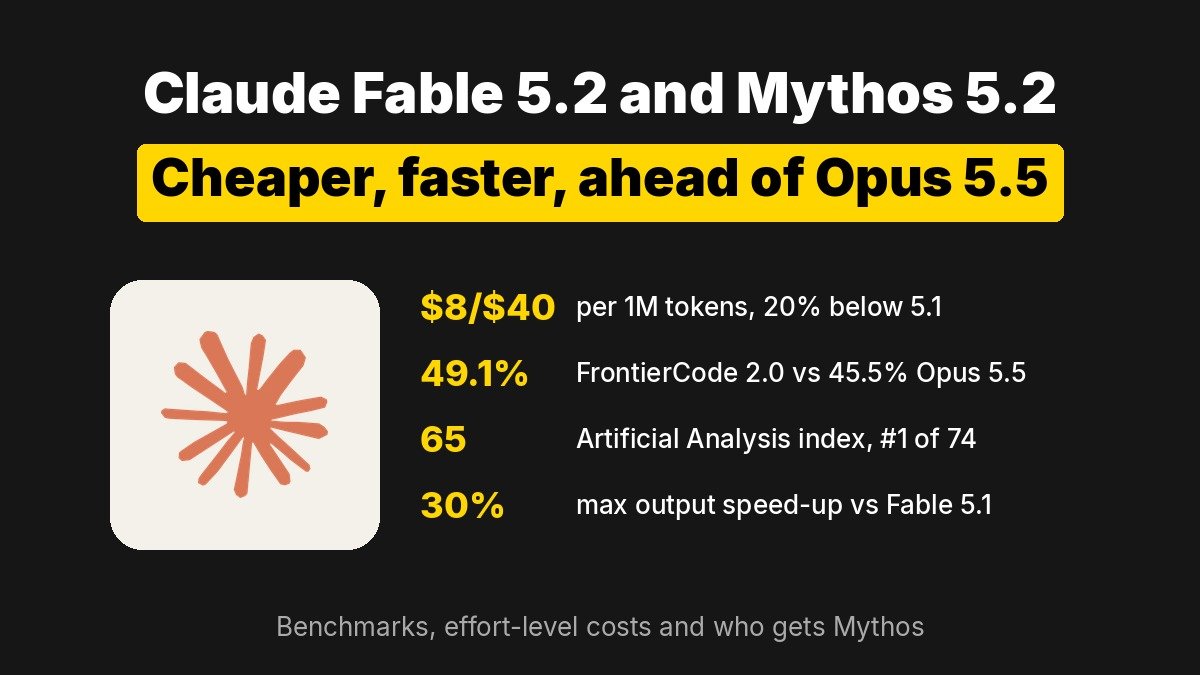
Short answer: Anthropic has released Claude Fable 5.2 and Claude Mythos 5.2, an upgrade to its top-tier models that is about 20% cheaper than Fable 5.1 ($8 input and $40 output per million tokens) and up to 30% faster. Fable 5.2 is available to everyone on the Claude Platform, AWS, Google Cloud and Azure, while Mythos 5.2, the same model with fewer cyber and biology restrictions, stays limited to vetted organizations. For most builders the practical news is cost: Anthropic says Fable 5.2 at High effort matches Opus 5.5’s best coding score for roughly half the cost per task.
What did Anthropic ship?
Anthropic announced Fable 5.2 and Mythos 5.2 as its models for “the most daunting technical challenges.” The two names cover one underlying model. Fable carries strong cybersecurity and biology safeguards so it can be offered to all users. Mythos is the less restricted version, available only through Anthropic’s Cyber and Life Sciences Verification Programs.
- Model ID:
claude-fable-5-2on the Claude Platform - Price: $8 per million input tokens and $40 per million output tokens, down from $10 and $50 for Fable 5.1, according to Anthropic’s pricing page
- Cache reads: $0.20 per million tokens; Batch API halves input and output to $4 and $20
- Fast mode: optional, up to 2.5x faster token generation at $16 input and $80 output
- Speed: outputs up to 30% faster than the 5.1 models, per Anthropic
- Context: 1M tokens, per Artificial Analysis
How much better is it on benchmarks?
Anthropic’s own table puts Fable 5.2 ahead of Opus 5.5 on almost every evaluation it lists. These are vendor-run numbers, mostly at the highest effort setting, so treat them as a claim rather than a verdict.
| Benchmark | Fable 5.2 | Fable 5.1 | Opus 5.5 | GPT-6 Astra | Gemini 4 Carbon |
|---|---|---|---|---|---|
| FrontierCode 2.0 (agentic coding) | 49.1% | 32.4% | 45.5% | 42.8% | 41.1% |
| FrontierSWE v2 (agentic coding) | 69.9% | 56.3% | 62.3% | 65.5% | 61.2% |
| AutomationBench (business workflows) | 51.4% | 31.4% | 42.5% | 41.4% | 53.9% |
| OSWorld 2.1 (computer use) | 89.3% | 83.5% | 87.2% | 79.5% | 81.5% |
| Remote Labor Index (knowledge work) | 41.3% | 17.9% | 21.3% | 20.8% | n/a |
| Humanity’s Last Exam (with tools) | 74.2% | 65.6% | 67.7% | 57.2% | n/a |
| RoboDojo Sim (robotics) | 64.9% | 27.6% | 39.4% | 29.8% | n/a |
Two details are worth noticing. Gemini 4 Carbon still edges Fable 5.2 on AutomationBench, so this is not a clean sweep. And the biggest jumps, on the Remote Labor Index and RoboDojo, are on tasks where the previous model was weak, which makes them more striking but also less tested.
Independent numbers point the same way. Artificial Analysis ranks Fable 5.2 (Max) first of 74 models on its Intelligence Index with a score of 65. The same page also calls it “particularly expensive,” “notably slow per task” and “very verbose”: it averaged 46.4 minutes and $26.54 per Intelligence Index task, and generated 275M output tokens during the evaluation against a median of 72.8M.
Is Fable 5.2 worth the cost over Opus 5.5?
It depends on effort level, and that is the most useful part of the launch for anyone paying API bills. Anthropic publishes accuracy-versus-cost charts that show:
- On FrontierCode 2.0, Fable 5.2 at High effort scores 45.3%, about level with Opus 5.5 at Max (45.5%), for roughly half the cost per task.
- On Perplexity’s WANDR agentic search benchmark, Fable 5.2 at Medium matches Opus 5.5’s top score for about 40% of the cost.
- On Humanity’s Last Exam, Fable 5.2 at Low effort matches Opus 5.5’s best for under one-tenth of the cost.
The catch is per-token price. Fable 5.2 still costs twice as much as Opus 5.5 ($4 and $20). It only comes out cheaper when it finishes in far fewer tokens, which is why the effort setting matters. Anthropic itself still recommends starting with Opus 5.5 as the daily driver and moving up to Fable only when the task needs it. Medium effort is the default in Claude apps and Claude Code.
Fable 5.2 can also run as an Advisor, which smaller Claude models consult on hard problems, or as an Orchestrator that hands simple subtasks to cheaper models. For teams with agent pipelines, that is the cheapest way to try it: keep Sonnet or Opus doing the bulk of the work and route only the hard calls upward.
What did it do in Anthropic’s testing?
Anthropic’s examples lean heavily on long, multi-agent runs:
- An engineer had Fable 5.2 coordinate more than 1,000 subagents for eight days to build a prototype operating system from an empty folder. It boots on a laptop with drivers, file storage, windows and an installer.
- A team of agents running an earlier version migrated a production service from Python to Rust; Anthropic says it now starts about 26 times faster.
- About 1,000 Fable 5.2 agents formalized Fermat’s Last Theorem in Lean in 30 hours. Opus 5.5, with the same setup, finished 26% in 18 hours.
- From a one-paragraph prompt, it designed three electronic devices with circuit boards, enclosures and software, built with Diode. All three worked without electrical changes.
- It solved two open problems on black holes in theoretical physics, written up as preprints.
Over 90% of changes merged into Anthropic’s core codebase are now written by Claude with human guidance, the company says. Early-tester quotes from Vercel, Shopify, Datadog, Uber, Oracle and Snowflake mostly praise the same thing: it needs less correction and admits when it does not know. Those testers were picked by Anthropic, and the post notes that outside organizations did not review its claims.
What changes for security teams with Mythos 5.2?
Mythos 5.2 is Anthropic’s strongest cybersecurity model. On its internal CVE Rediscovery test against 1,829 published vulnerabilities, it found 10.2% more than Opus 5.5 and 14.4% more than Mythos 5.1. Mozilla says it roughly doubled Mythos 5.1’s vulnerability discovery metrics while hardening Firefox. A footnote adds an honest caveat: on Anthropic’s own system card evaluations, vulnerability identification is roughly on par with Opus 5.5.
Fable 5.2 will block most cybersecurity tasks, so pentesters and security researchers still need the Cyber Verification Program. Claude Enterprise customers can also reach Mythos 5.2 through Claude Security, Anthropic’s codebase scanner.
What about data retention?
This is the fine print for companies. Because misuse can only be spotted across many requests, Fable and Mythos rely on safety monitoring over a window of usage data, and standard customers get 30-day retention. Enterprise Frontier Safeguards, now in private beta with Bridgewater, Salesforce and Stripe, runs that monitoring inside the customer’s own infrastructure so zero data retention still works. If your company has a no-retention policy, check with your account team before you switch.
Who can use it today?
Fable 5.2 is live on the Claude Platform, Amazon Web Services, Google Cloud and Microsoft Azure. Fast mode is on Claude Code, the Claude Platform, Claude Models on Google Cloud and Microsoft Foundry. For subscribers, Anthropic is running a launch promotion this week: eligible paid plans get one to three Fable usage resets, and Pro plans and standard Team seats can spend up to 50% of their weekly limits on Fable.
What should builders do now?
- If you run Fable 5.1 in production, switch the model ID and re-test. The same quality should cost about 20% less per token before any token savings.
- If you run Opus 5.5, do not swap wholesale. Try Fable 5.2 at High or Medium effort on your hardest 10% of tasks and compare total cost per finished task, not price per token.
- If you build agents, test the Advisor pattern first. It caps how much of your traffic hits the expensive model.
- Watch the verbosity. Artificial Analysis measured far more output tokens than the median model, and output is the expensive side at $40 per million.
Sources
- Anthropic: Introducing Claude Fable 5.2 and Claude Mythos 5.2
- Claude Platform pricing
- Artificial Analysis: Claude Fable 5.2 model page
Image credit: Anthropic