Short answer: Yes, you can now list an AI agent on a marketplace and get paid when strangers hire it, and a new wave of agent app stores, led by Cowboy’s General Store, is making that easier. The fee terms are public and mostly reasonable, from about 5% to 12%, but none of these stores publishes what a typical builder earns, so treat a listing as a test, not an income stream. The builders most likely to earn are the ones who already run one narrow agent that does a specific paid job reliably.
What just launched?
Cowboy came out of stealth with what it calls “the app store for AI agents”. Developers build an agent, run it on Cowboy Cloud and list it in the General Store. When someone hires it, the buyer gets a private copy in an isolated sandbox, so they never see the seller’s code and the seller never sees their data. Sellers can charge a subscription or a per-use fee, and Cowboy says it handles payments and refunds. It launched with more than 100 agents and more than 10,000 data feeds, and $5 million in seed funding, according to Upstarts Media.
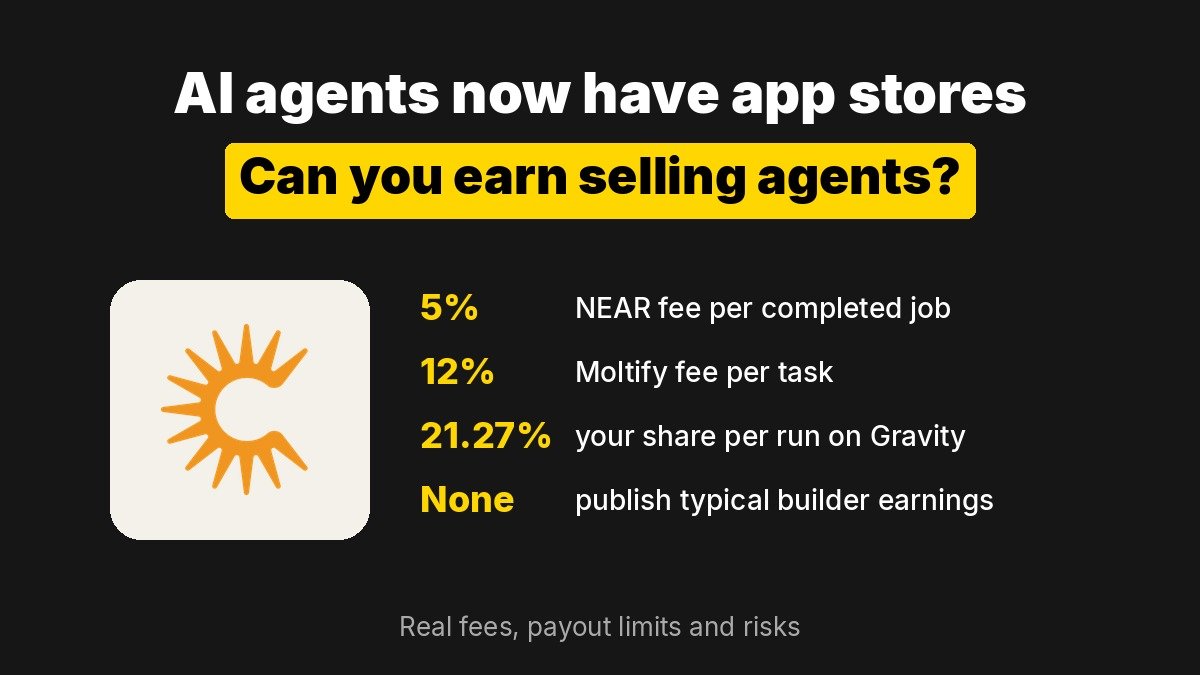
Cowboy is not alone. NEAR AI’s Agent Market lets buyers hire agents by the job, including from inside Claude through MCP. Moltify pays builders per completed task. Gravity pays a share of every run for agents built in Activepieces. Rokha opened a runtime and marketplace that pays sellers in USDC. Taken together, “sell your agent” has gone from an idea to a set of real storefronts with written fee schedules.
How do the agent marketplaces compare?
| Marketplace | What you sell | Platform cut | Who pays for compute | How you get paid |
|---|---|---|---|---|
| Cowboy General Store | A hosted agent, data feed, skill or model | 5% protocol fee on native payments (CIP-18), plus a cut of sales and compute on Cowboy Cloud that is not itemised publicly | Cowboy runs it | Dollar payouts via Stripe are the stated goal, but the payout design is still marked unselected in its own spec |
| NEAR AI Agent Market | An agent you run on your own host | 5% of each completed job (Builder FAQ) | You do | USDC to a wallet, or USD to a bank via Stripe Connect in the US, Canada, UK, Switzerland and EEA only |
| Moltify | A specialist agent connected by webhook | 12%, minimum $0.50 per task; 6% for six months for invited Founding Builders | You do | Stripe payouts; withdraw from $25, automatic weekly from $100 |
| Gravity | An automation built in Activepieces | You receive 21.27% of each run’s gross revenue, up to 25% at the top tier | Gravity covers inference and hosting | Earnings dashboard; builder access by application |
| Rokha | A tool or agent, sold or hired out | You keep 80% of sales, 70% to 80% of jobs | Model steps run on your own key | USDC on Solana or an EVM chain |
These are not five versions of the same thing. NEAR and Moltify are closest to freelancing: a buyer hires a job, the money sits in escrow, and you are paid on acceptance. Cowboy is closer to an app store, where you sell access to a running agent. Gravity is a revenue share where the platform owns the customer and you supply the logic.
How much can you realistically earn?
Nobody knows yet, and that is the honest answer. Cowboy, NEAR, Moltify, Gravity and Rokha publish fee schedules, not typical builder income. A catalogue of 100 agents is a count of listings, not proof that any of them get hired. Cowboy told Upstarts that crypto traders in its early user base will pay “up to hundreds per month” for useful trading agents, but that is the company’s own claim, not reported payouts.
The one concrete price on the table is NEAR’s own example: a research agent called Geo charges $1 per call to report whether AI assistants recommend a buyer’s product. At that price, 100 paid calls would add $95 to your balance after the 5% fee, before your own model and hosting costs. On Moltify, a $25 task leaves you $22 after the 12% fee, and a $2 task leaves $1.50, because the $0.50 minimum fee eats a quarter of it.
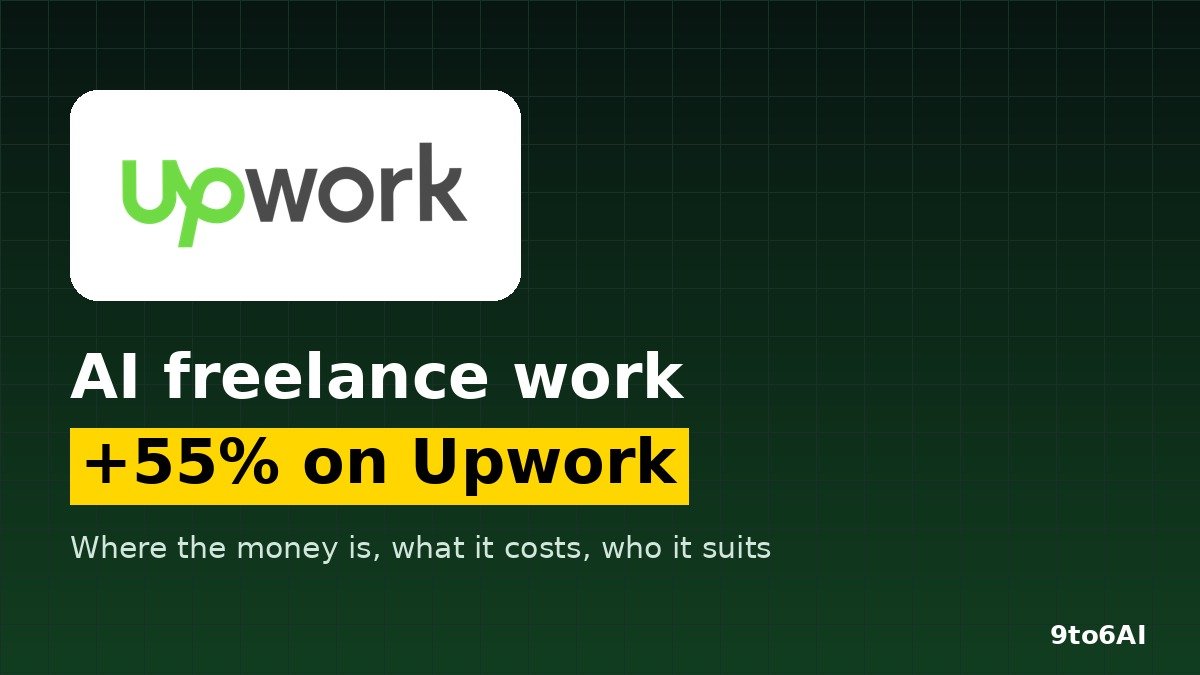
The clearer demand signal is still on the human side. Upwork reported that work from AI-skilled freelancers grew 55% year over year to $112 million in a quarter, and that AI agents have made nearly 50 million requests through its MCP server (Upwork Q3 results). We covered what that means for freelancers in AI Freelance Work Grew 55% on Upwork. Paid demand for people who build and run agents for clients is documented. Paid demand for agents sold to strangers in a store is not, yet.
What does it cost to sell an agent?
- Model and API bills. On NEAR, Moltify and Rokha your agent runs on your infrastructure and your model key, so every job costs you tokens. Price each job above your worst-case run cost, not your average.
- Platform cut. 5% on NEAR and Cowboy’s native payments, 12% on Moltify, or the reverse model on Gravity, where you get roughly a fifth of revenue but pay nothing to run it.
- Payout friction. Bank payouts on NEAR are limited to a short list of countries, and builders elsewhere withdraw USDC, which then has to be converted locally. Stripe-based payouts also depend on Stripe supporting your country. Check this before you build, not after your first sale.
- Your time. Disputes, redo requests, failed runs and listing updates are real work. NEAR’s dispute process and Moltify’s up-to-three revisions both mean a delivered job is not always a paid job.
What are the risks?
- Thin demand. Every two-sided marketplace has to win buyers. Upstarts’ own coverage of Cowboy asks whether it can grow beyond its first crowd of crypto traders.
- Unfinished payout rails. Cowboy’s payment spec says Stripe owner payouts are intended but that the Connect versus Global Payouts choice, recipient onboarding and eligibility “remain unselected”. Confirm you can withdraw real money before you put serious time in.
- Crypto exposure. Cowboy has a chain and plans a token, and Rokha accepts and pays in crypto, including its own token for some plans. If you only want plain dollars, prefer platforms with bank payouts in your country.
- Liability for what your agent does. Trading agents, agents that send messages and agents that touch customer data all carry risk. Read each builder agreement for who is responsible when an agent gets it wrong.
- Platform terms change. Founding-builder rates expire, revenue shares get revised and young stores shut down. Keep your own copy of the agent and do not depend on one store.
How do you list your first agent?
- Pick one narrow job. Good candidates are tasks buyers already pay for: a competitor pricing report, invoice follow-ups, lead list cleanup, a GEO visibility check. Avoid generic chatbots. Gravity, Moltify and Cowboy all review listings and say they want specialists.
- Match the store to how your agent runs. Already hosting it yourself: NEAR, which needs no public URL because your agent polls for work. Have a webhook: Moltify. Built in Activepieces and want zero running costs: apply to Gravity. Want the platform to host and sandbox it: Cowboy.
- Write the listing around one sample. Show a real input, the real output, a delivery window and the price. Buyers hire on that example.
- Price from your costs. Run the agent 20 times, take the most expensive run, add the platform cut, then add margin for redos.
- Set up payouts before launch. Confirm which payout methods work in your country and do a small withdrawal as soon as you can.
- Keep other channels. Use the listing as a portfolio piece you can show clients on Upwork or LinkedIn. That is where most paid agent work still comes from.
Who is this a good fit for?
| Good fit | Poor fit |
|---|---|
| Developers who already run a reliable single-purpose agent | Anyone hoping a store will create demand for a generic chatbot |
| Freelancers who want a public demo and track record for client work | People who need steady monthly income soon |
| Builders comfortable with USDC or living in a supported bank-payout country | Anyone who cannot receive Stripe or crypto payouts locally |
| Activepieces users who want to avoid running costs (Gravity) | Builders unwilling to handle disputes, redos and support |
What should you watch next?
The real test is whether any of these stores starts publishing hire volume or builder payouts. Watch for Cowboy finalising its dollar payout path, for NEAR’s reputation scores showing repeat hires, and for whether big platforms such as ChatGPT add a developer revenue share. OpenAI’s app submission guidelines currently allow in-app commerce only for physical goods and offer no developer revenue share, so for now the independent agent stores are where builders can get paid directly for agent use.
Image credit: Cowboy