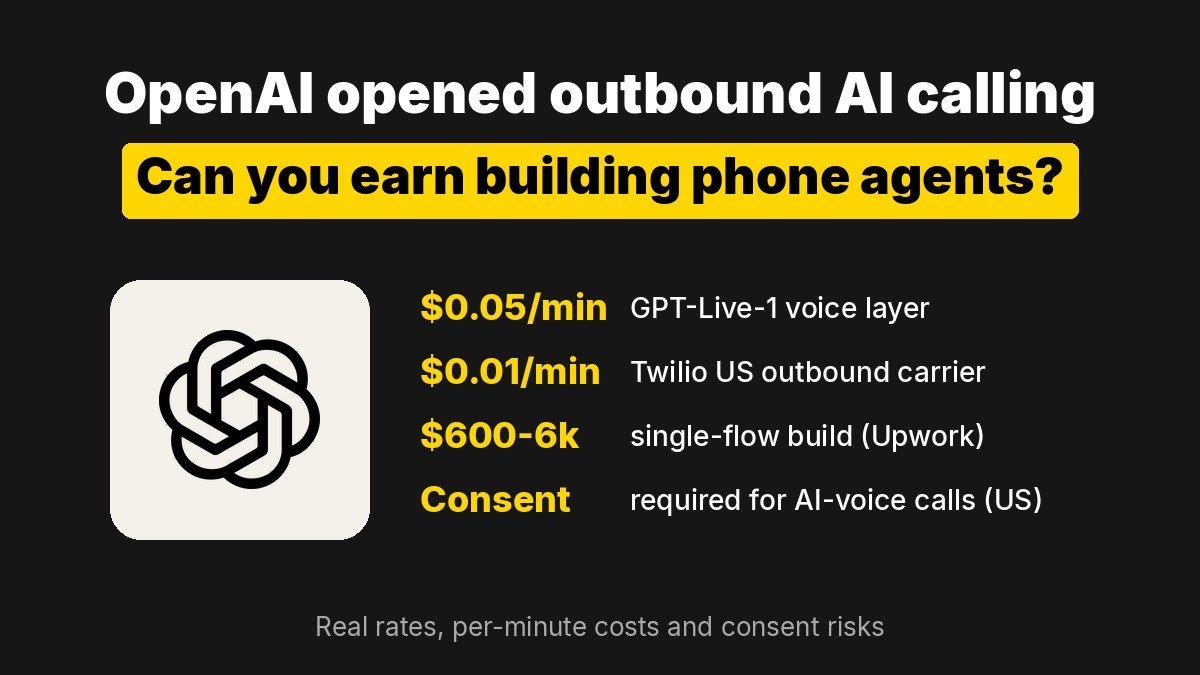
Short answer: Yes, there is real paid work in building AI phone agents for small businesses, and OpenAI just made it easier: outbound calling through its Live API is now open to all developer organizations, with the GPT-Live-1 voice layer priced at $0.05 per minute. The money is in setup and monthly upkeep of agents that call people who already expect the call, such as appointment confirmations and callbacks. It is not a passive income play, and cold-calling with an AI voice carries serious legal risk.
What did OpenAI actually change?
OpenAI’s Telephony and SIP guide now states that “outbound SIP calling is available to all organizations through the Live API.” OpenAI’s Justin Uberti announced that the outbound telephony API had reached general availability, naming Twilio and Telnyx as example SIP trunk providers, and Greg Brockman shared it the same day.
Inbound phone calls already worked. What is new is that your backend can create a session that dials a phone number itself. The voice model is GPT-Live-1, which listens and speaks at the same time and hands deeper reasoning and tool calls to a backend text model you choose.
- You place a call with
POST /v1/live/sessionsand a SIP transport block holding the destination number, your trunk address and trunk credentials. - A backend WebSocket “sideband” reports ringing, answered and failed events, and lets you send keypad tones, transfer the call or hang up.
- Ringing is capped at 3 minutes and a connected call at 2 hours. Neither limit is configurable.
- Destinations must be real phone numbers in international format; SIP addresses are not supported.
Who pays for AI phone agents today?
Businesses that lose money on missed or repetitive calls: clinics, salons, home services, real estate, restaurants and agencies that resell to them. Upwork’s AI voice agent hiring page describes the typical jobs as customer inquiries, appointment scheduling, lead qualification and routine service requests, and the featured freelancers list work such as AI receptionists, booking agents and lead follow-up callers connected to CRMs like GoHighLevel and HubSpot.
The buyers also have cheap off-the-shelf options, which caps what you can charge for simple setups:
| Option | Published price | What it means for you |
|---|---|---|
| Goodcall Starter | $79/month for 100 unique customers | A basic answering agent is already cheap. You must offer more than that. |
| Smith.ai AI Receptionist Pro | $150/month for 75 calls ($2.00/call) | Per-call pricing sets a ceiling businesses compare you against. |
| Custom build on GPT-Live-1 | Voice layer $0.05/min plus carrier and backend model | Worth it when the client needs custom outbound flows, integrations or their own data. |
The gap a freelancer can fill is custom work those products don’t cover well: calling a clinic’s own patient list to confirm tomorrow’s appointments, calling back a missed caller with real availability from the booking system, or following up a web lead within minutes and logging the result in the CRM.
How much can you realistically earn?
Upwork’s own guide puts AI voice agent developers at $30 to $150 per hour, with these typical project ranges:
| Project type | Upwork’s typical range |
|---|---|
| Single-flow voice agent (one call flow, basic setup) | $600 to $6,000 |
| Multi-intent assistant with CRM and booking | $1,200 to $12,000 |
| Production deployment with live telephony and analytics | $2,400 to $24,000 |
| Ongoing maintenance and optimization | $1,500 to $4,500 |
Be realistic about where you start. Several of the featured voice AI freelancers on that same page, including sellers in Pakistan and India with strong reviews, list hourly rates between $12 and $30. That is the competition a new profile faces. The top of Upwork’s range goes to people with recorded demos, case studies and production deployments, not to first-time sellers. Nobody publishes a reliable “average income” for this work, and you should distrust anyone who promises one.
The steadier money is the monthly retainer. Agents drift: menus change, staff change, prompts need tuning, call logs need review. Pricing setup plus a monthly fee for monitoring and fixes is how most agencies on these marketplaces describe their offer.
What does one call cost you to run?
Your margin depends on per-minute costs you can calculate before quoting. For a US call over Twilio:
| Cost item | Published rate |
|---|---|
| GPT-Live-1 voice layer | $0.05/min (OpenAI) |
| Twilio Elastic SIP outbound, US 48 states | $0.010/min (Twilio) |
| Twilio local phone number | $1.15/month |
| Call recording (optional) | $0.0025/min |
| Backend reasoning model and tools | Billed separately by tokens; check current OpenAI pricing |
So a three-minute confirmation call costs roughly $0.18 in voice and carrier fees before backend model usage. Rates differ by country and carrier, so recalculate for your client’s market. Remember the hidden cost: your time spent testing, fixing and reviewing failed calls.
How do you get started this week?
- Pick one narrow use case. Appointment confirmation calls for existing customers are the safest first offer: the person expects the call and the outcome (confirm, cancel, reschedule) is easy to measure.
- Build a demo on your own number. Set up an OpenAI API project, a SIP trunk with TLS and SRTP enabled (Twilio or Telnyx), and follow OpenAI’s “Place an outbound call” steps. Call yourself, not strangers.
- Connect one real system. A calendar or booking tool the agent can read and update is what separates a paid build from a toy.
- Record the demo and write the failure cases. Show what happens on voicemail, a wrong number, an interruption and a request it can’t handle. Buyers on Upwork are told to ask for exactly this.
- Offer a fixed-price pilot. One flow, one location, a clear success measure, then a monthly fee for upkeep.
What are the risks before you take money?
- Consent law. In the US, the FCC ruled that AI-generated voices count as “artificial” voices under the TCPA, so these calls need the called person’s prior express consent, and telemarketing calls need prior written consent (FCC). Other countries have their own telemarketing rules. Avoid cold-call campaigns and get the client’s consent process in writing.
- Duplicate calls. Every session-creation request starts a new call. If your request times out and your code retries blindly, the customer can get called twice. Build deduplication in from day one.
- Task success is not proven. OpenAI’s launch material shows benchmarks and customer quotes, but there is no published completion rate for outbound calls. Measure it yourself in the pilot before promising results.
- Platform dependence. Prices and API behaviour can change. Keep the client’s phone numbers, prompts and data in accounts they own.
- Data handling. Calls carry names, health or payment details. Clinics and similar clients need you to be careful about recording, storage and who can read transcripts.
Who is this a good fit for?
| Good fit | Poor fit |
|---|---|
| Developers comfortable with APIs, webhooks and WebSockets | People looking for passive or no-code income |
| Automation freelancers who already serve small businesses | Anyone planning cold-call lead generation |
| People willing to sell a monthly upkeep service | Sellers who want to build once and never touch it again |
If you already build automations, outbound calling is a useful new skill to add to them. If you are starting from zero, learn the basics on inbound and booking flows first, because outbound calling is where legal and reputational mistakes happen fastest.
Sources
- OpenAI: Telephony and SIP guide
- OpenAI: GPT-Live-1 in the API
- Justin Uberti on outbound telephony GA
- Upwork: AI voice agent developer rates and project costs
- Twilio: Elastic SIP Trunking pricing (US)
- Goodcall pricing and Smith.ai AI Receptionist pricing
- FCC: TCPA applies to AI-generated voices
Image credit: OpenAI