Short answer: Yes, several companies now pay people to film everyday chores from a head-mounted phone so the footage can train robots and other physical AI. Listed rates run from about $2 to $15 per accepted hour, with a few per-clip and higher-rate tasks in limited countries. It is real, low-skill gig work, but income depends on review, regional demand and how many hours you can actually record, so treat it as small pocket money, not a salary.
Why is everyone suddenly talking about this?
A TokenPost report on workers in Brazil described people strapping phones to their heads or chests to film dishwashing, sweeping, cooking, hotel cleaning and farm work for platforms that collect robot training footage. Some said they earn up to $1,000 a month. The two monthly figures in the story were about $363 and $544, both self-reported, and part of one total came from referral commissions.
The demand is real. Language models learned from text that already existed online, but a robot that folds laundry needs first-person video of hands doing exactly that in many different homes. That footage has to be recorded by people, which is why a wave of collection apps has opened to the public.
How does the work actually happen?
- You sign up and pick a task, or apply to a pool and wait for a project that fits.
- You mount a phone or action camera at head or chest height so your hands stay in frame.
- You do the task start to finish, following a written brief on length, angle, light and what must stay out of frame.
- A reviewer, usually a person plus automated checks, accepts or rejects the footage.
- You are paid only for accepted footage, through the platform’s payout method.
The word that matters is accepted. An hour of filming that fails review, or a clip cut short because a family member walked in, pays nothing.
What do the platforms actually pay?
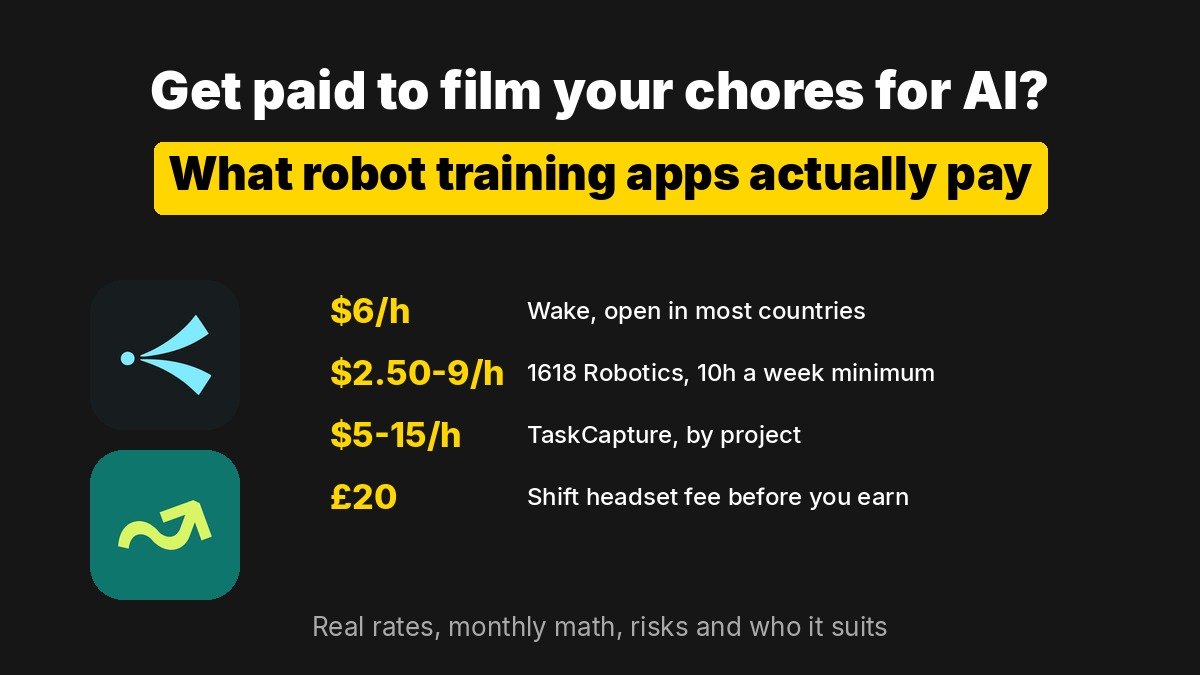
These are the rates each platform lists on its own pages. None of them guarantees how much work is available.
| Platform | Listed pay | Where it works | Key conditions |
|---|---|---|---|
| Wake | From $6 per approved hour; $15 per hour for US GoPro household tasks | Most countries in Africa, Asia, Europe, the Americas and Oceania, with some tasks limited to selected regions | Over 100 task briefs, from folding towels to changing a tire; any phone for most tasks |
| 1618 Robotics | $2.50 to $9 per accepted hour, by task | Opening country by country, with a waitlist | Must be 19 or older, record at least 10 hours a week, verified WhatsApp; head strap sent if needed |
| TaskCapture | $5 to $15 per accepted hour, varies by project | Pool based; instructions and support in Spanish and Portuguese | Review usually about a week; paid in USD through Wise; equipment provided when needed |
| GoKuna | $5 per object clip, $6 per sound set, $10 per first-person clip, $20 per accepted hour of day-in-motion footage | First-person clips open worldwide; the hourly task starts in North America; Stripe payouts only to banks in the US, UK, Canada, Switzerland and Europe | Reviewed usually within 24 hours; $20 minimum payout |
| Shift | £6 per accepted hour | UK only | You pay £20 up front for the headset; minimum 8 hours a week |
| Flambra and Hub Data (per TokenPost) | About $1.80 to $2.30 per hour for home tasks, $4.50 to $5.40 for workplace tasks | Brazil | Rates move with buyer demand; some users complained about blocked accounts and hard withdrawals |
How much can you realistically earn in a month?
Do the math with accepted hours, not time spent filming. At Wake’s $6 rate, 10 accepted hours a week is about $60 a week. At 1618 Robotics, the required 10 hours a week works out to roughly $25 to $90 a week depending on the task. Shift’s own calculator shows £48 a week at its 8 hour minimum, before you earn back the £20 headset.
Real worker reports sit in the same range. The Brazilian workers TokenPost spoke to reported a few hundred dollars for a month of steady recording, and one designer said offers rise when buyers want footage and fall when enough people contribute. Nobody in the reporting had a contract guaranteeing steady work.
That makes this most attractive where these dollar rates go further than local wages, and least attractive in high-cost countries unless you are filming chores you would do anyway.
Which tasks pay more?
- Workplace and trade tasks. Plumbing, car repair, hotel cleaning and farm work tend to pay more than home chores in the rates TokenPost listed, but you need written permission from whoever runs the workplace.
- Specific equipment. Wake’s $15 tasks require a GoPro HERO13 Black and a US location.
- Longer, continuous footage. GoKuna’s highest rate is for long day-in-motion recordings, not short clips.
What are the risks before you sign up?
- Privacy at home. Your camera sees your home. Platforms ask you to keep faces, mail, screens, ID documents and license plates out of frame, and anyone identifiable needs to sign a release. Record when you are alone.
- You give up control of the footage. GoKuna, for example, says accepted recordings are licensed for model training, and footage already delivered to a customer stays licensed even if you delete your account. Workers in the TokenPost report did not know which companies bought their videos.
- Up-front fees. Most platforms say you never pay to join. Shift charges £20 for its headset. Paying to start work is a pattern scams copy, so check any platform that asks for money before you earn anything.
- Payout problems. Some Brazilian users reported blocked accounts and difficult withdrawals on one platform. Start small and withdraw early to confirm payouts work in your country.
- Unstable demand. Rates and available tasks change as buyers collect enough footage. Weekly minimums can push you to film more than you planned.
- Safety and tax. Only record tasks you are qualified to do safely, and treat payouts as contractor income in your country.
Who is this for, and who should skip it?
It suits people with time at home, a decent phone and a steady routine of chores, especially in countries where a few dollars an hour is meaningful, and tradespeople who can record real work with their employer’s permission. It does not suit anyone who needs predictable income, shares a busy home where others would appear on camera, or is uncomfortable licensing video of their living space.
How do you start without getting burned?
- Check country support and payout method first. A platform open in your country is useless if it cannot pay your bank or wallet.
- Prefer platforms with no joining fee. Wake, 1618 Robotics, TaskCapture and GoKuna all say applying is free.
- Start with the shortest task. GoKuna suggests a short object or sound task first to learn how briefs and review work.
- Read the brief twice. Most rejections come from framing, light or people in shot.
- Track accepted hours, not recorded hours. After two weeks, divide what you were paid by the time you spent. That is your real rate.
- Keep your day job. Treat this as a top-up, and drop any platform that delays payouts.
What should you watch next?
Robot companies need far more real-world footage than exists today, so more of these apps are likely to open. The useful signals are stable rates, wider payout coverage and clear terms on who buys the footage. Until those improve, filming chores for AI is a small, honest side income for the right person, not a way to replace a job.
Image credit: Wake and GoKuna