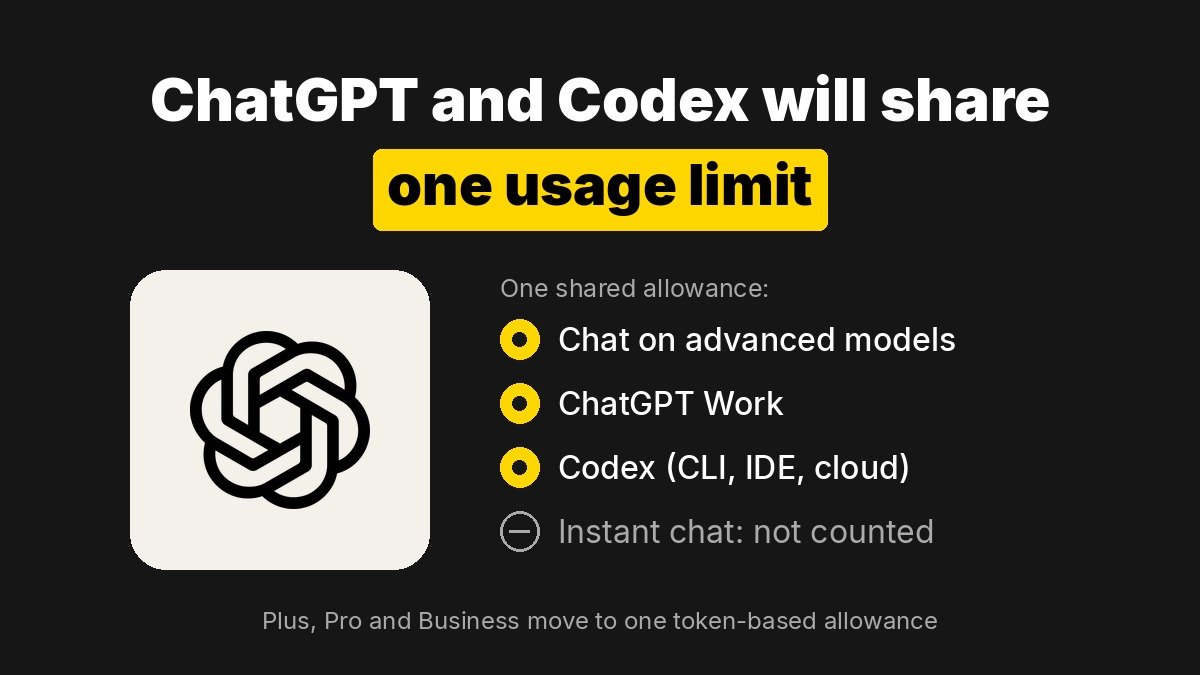
Starting in December, ChatGPT Plus, Pro and Business plans will have one shared, token-based allowance covering both ChatGPT and Codex. Instant chat stays unlimited, but conversations with more advanced models will draw from the same pool as your coding agent. OpenAI says most people will not hit resets more often than they do now. Heavy Codex users, and anyone who used ChatGPT chat as an unmetered side channel, should expect to run out sooner.
Key points
- OpenAI’s Help Center says usage on Plus, Pro and Business “will be shared across ChatGPT and Codex as we bring the agentic capabilities of Work into the main ChatGPT experience.”
- Usage is measured in tokens. How much a request uses depends on the model and the task, and advanced models and complex tasks use more.
- Instant chat is included and does not draw from the shared allowance.
- Your combined remaining usage and reset times will show in Settings → Usage. Once it runs out, you can wait for the reset, upgrade or buy credits.
- Separately, OpenAI has already doubled the Work and Codex allowance on Pro 100 and Pro 500 and cancelled a planned cut on Pro 200. Plus usage is unchanged.
- OpenAI has not published token amounts per plan, the exact switch-over day or new 5-hour and weekly figures.
What is OpenAI changing?
Today, ChatGPT and Codex are metered separately. Codex, local and cloud, already shares one allowance with ChatGPT Work, the agent mode that builds files, sites and decks. Regular Chat runs on its own per-model message limits, and for most paid users it has felt close to unlimited.
That split is ending. According to OpenAI’s usage limits help article, the allowance on Plus, Pro and Business will be shared across ChatGPT and Codex from December. The change rides along with a bigger product shift. OpenAI emailed subscribers that it will start testing a combined Chat and Work experience with a small group of users in the coming weeks, so you can go from discussing an idea to having ChatGPT carry it out in one place. According to BleepingComputer, which saw the email, Codex stays a separate experience in the ChatGPT desktop app. Only the meter is being unified.
The email puts it this way: “We expect most users won’t need to wait for their usage to reset more often than they do today.”
How will the shared allowance work?
Everything except Instant draws from one token pool. A quick question to a reasoning model, a long Work task with files and plugins, and a Codex session refactoring a repo all draw from the same balance. They just draw at very different rates.
OpenAI’s Pro plan page lists what drives the rate: the model, how much context is processed, reasoning, tool use, retrieval, caching and speed mode. Fast mode burns the allowance at 2.5 times the Standard rate. Ultrafast on GPT-6 Astra and GPT-6.1 Sol, available only on Pro 500, burns it at 8 times.
| Today | After the change | |
|---|---|---|
| Codex (CLI, IDE, cloud) | Shares an allowance with ChatGPT Work | Shares one allowance with all of ChatGPT |
| ChatGPT chat on advanced models | Separate per-model message limits | Draws tokens from the shared allowance |
| ChatGPT Instant | Included | Still included, does not draw from usage |
| Where to check | Codex /status and Settings → Usage | Combined balance and resets in Settings → Usage |
| When you run out | Codex and Work pause, chat keeps going | Everything except Instant pauses until reset, upgrade or credits |
| Plans affected | n/a | Plus, Pro, Business |
Enterprise and Edu workspaces on flexible pricing already run on credits, and Codex used with an API key is billed per token, so neither path is part of this change.
Who is most likely to feel it?
Codex power users on Plus. On the Codex pricing page, a Plus 5-hour window is a range of roughly 15 to 160 local messages on GPT-6.1 Sol and 5 to 45 on GPT-6 Astra. If you regularly drain that window, you will no longer have chat on a reasoning model to fall back on while you wait.
People who used Chat as a free coding lane. On Hacker News, developers describe planning and reviewing code in Chat, pasting diffs and logs in, or using the GitHub connector there, precisely because it did not touch their Codex limit. That workaround goes away.
Researchers on GPT-6 Pro. OpenAI says the weekly GPT-6 Pro message limits in Chat are “separate from your Work and Codex allowance” today. It has not said whether those long, expensive Pro conversations will also start eating the shared pool. Several Pro subscribers on Hacker News say they will leave if they do.
Light chat users. If you mostly use Instant, or a few thinking-model chats a day, you will probably notice nothing. That is the group OpenAI’s “most users” line is about.
Is this a price increase?
Not on paper. Plan prices stay the same, and Pro just got more Work and Codex usage. Pro 100 and Pro 500 doubled their allowance, and on Pro 200 the lower tier doubled to match the higher one after OpenAI scrapped an earlier plan to cut it. Plus did not change.
In practice it narrows what a flat fee buys. The Decoder calls it the end of all-you-can-prompt pricing. Only Instant stays flat-rate, so heavy users on cheaper plans will increasingly be pushed toward lighter models or toward credits. It is the same pressure behind the recent OpenAI and Anthropic price moves: compute for agents is expensive, and subscriptions are being reshaped around it.
It also brings ChatGPT in line with Claude. Anthropic’s paid plans already count chat and Claude Code against the same session and weekly limits, which was one reason some developers preferred ChatGPT for everyday questions.
What should builders do before December?
- Learn your real burn rate now. Run /status in Codex and watch Settings → Usage for a normal week, noting which sessions take the biggest share.
- Match the model to the job. Use Instant or a Luna-class model for quick questions and lookups, and save Sol and Astra for work that needs them. Model choice is now your main cost lever.
- Keep Fast and Ultrafast for deadlines. At 2.5 times and 8 times the Standard rate, they are the quickest way to empty the shared pool.
- Split work across accounts or keys where it makes sense. A team can keep heavy automation on an API key with usage-based billing, so the subscription pool stays free for interactive work.
- Check plan math before upgrading. If you only run out in a few heavy weeks, credits may cost less than moving from Plus to Pro 100.
- Keep a second model handy. If your chat and coding now stop at the same moment, a fallback such as another vendor’s plan or an open-weight model keeps you working.
What to watch
- Concrete token allowances or ranges per plan once the shared meter goes live.
- Whether the GPT-6 Pro weekly message limit becomes part of the shared pool or stays separate.
- How the Codex plan page and the Help Center line up. They currently describe limits in different terms.
- Whether OpenAI adds a small reserve for chat when Codex has used the rest, something many users are asking for.
- How fast the combined Chat and Work experience moves from a small test group to everyone.
Sources
- OpenAI Help Center: Understanding ChatGPT and Codex usage limits
- OpenAI Help Center: About ChatGPT Pro tiers
- OpenAI: Codex pricing and usage
- OpenAI Help Center: Using Codex with your ChatGPT plan
- BleepingComputer: OpenAI is doubling Pro usage limits and bringing Work features to Chat
- The Decoder: OpenAI’s chat-and-work merger signals the end of all-you-can-prompt pricing
- Hacker News discussion