
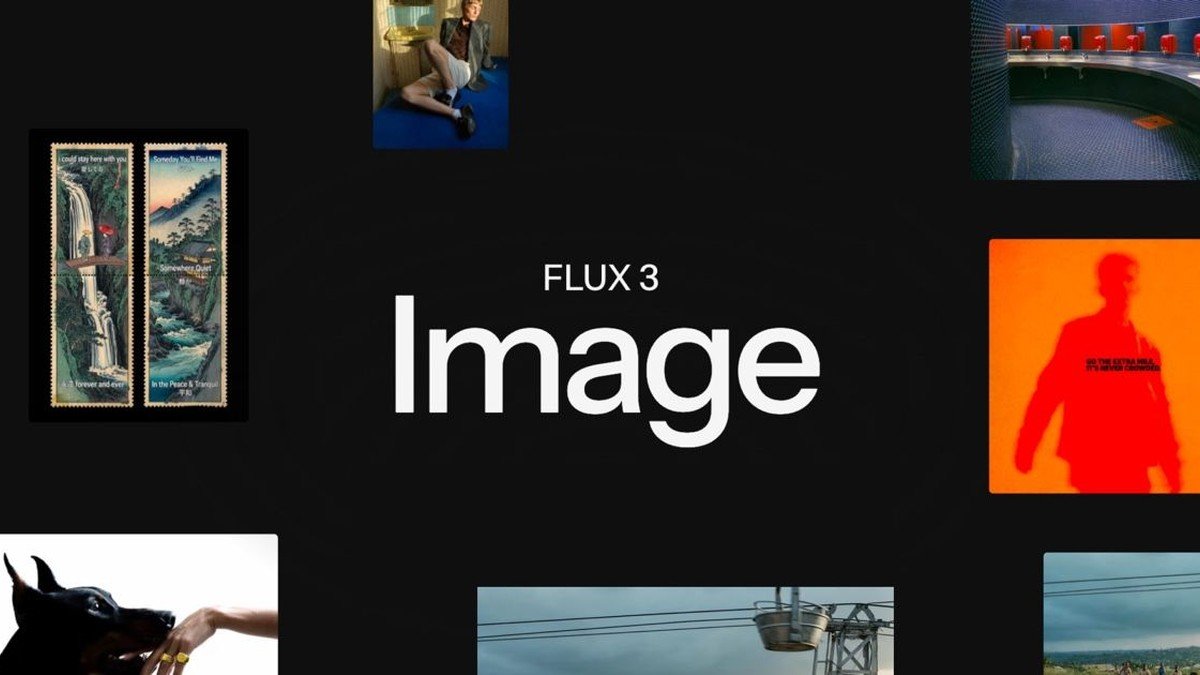
Black Forest Labs introduced FLUX 3 Image — the image generation and editing tier of its FLUX 3 multimodal family — as a metered API at api.bfl.ai/v1/flux-3-image. The builder pitch is spatial control: compose or edit with bounding boxes on a 0–1000 canvas, run several targeted edits in one pass, and (per BFL) leave untouched regions looking the same. The product page also advertises up to 10 reference images, native 2K and 4K output (example 5456×3072), and an agent-friendly layout path where an LLM plans the boxes. On Hacker News the launch sat near the front with roughly 285 points in the Saturday-morning radar window — the clearest image-gen spike after this week’s model and harness coverage.
Treat “pixel-perfect” and “usually stay identical” as vendor claims until you verify on your own frames. 9to6AI has not hands-on tested FLUX 3 Image.
Image credit: Black Forest Labs
Key points
- What shipped: FLUX 3 Image — image gen + edit API tier of the FLUX 3 Self-Flow multimodal family (family announced earlier; image tier now live and metered).
- Control surface: Bounding boxes on a 0–1000 grid; each box
[y_min, x_min, y_max, x_max]; element table withid/bbox/descplus a scene caption that cites those ids. - Multi-edit: Multiple targeted edits in one request; BFL says untouched pixels “usually stay identical” — hedge that wording as a vendor claim.
- References & resolution: Up to 10 reference images; native 2K and 4K (example 5456×3072).
- Agents: LLM can plan a caption + element table from one line + aspect ratio; boxes stay editable before generate.
- API:
api.bfl.ai/v1/flux-3-image - Pricing (secondary — OrcaRouter; verify on BFL billing/help): per image by resolution — $0.041 (768²), $0.048 (1K default), $0.07 (1.5K), $0.10 (2K), $0.607 (4K). 50% launch discount through October 8 ~15:00 UTC.
- Weights: Commercial weights license available (contact sales). Public open weights described as “coming weeks” — not out yet.
- Family context: FLUX 3 Video already GA (per-second); FLUX 3 Action partner-gated. Same window: Ideogram 4.5 also editing-focused (market context, not the lead).
- Caveats: Naming confusion (family vs image tier). Artificial Analysis may not list FLUX 3 Image scores yet. 9to6AI has not hands-on tested.
What shipped
FLUX 3 Image is not a greenfield brand — it is the still-image surface of the FLUX 3 family BFL has been shipping in pieces. The product page centers composition (boxes + caption), multi-region editing, multi-reference assembly, native high-res, and agent layout planning.
| Field | Value |
|---|---|
| Product | FLUX 3 Image (gen + edit) |
| Org | Black Forest Labs |
| Family | FLUX 3 multimodal (Self-Flow) |
| API | api.bfl.ai/v1/flux-3-image |
| Canvas | 0–1000 grid; boxes [y_min, x_min, y_max, x_max] |
| References | Up to 10 |
| Native res | 2K and 4K (example 5456×3072) |
| Commercial weights | Available via sales |
| Public open weights | Stated as coming weeks (not released) |
| Related tiers | FLUX 3 Video (GA, per-second); FLUX 3 Action (partner-gated) |
Official product page: bfl.ai/models/flux-3-image. Family context: bfl.ai/blog/flux-3.
What changed vs prior FLUX and the market
Image tier is finally a priced API. The FLUX 3 family announcement leaned multimodal (image, video, audio, action). Video and a partner-gated Action head already had production shapes; the image endpoint is the conventional metered stills surface builders expect when they hear “FLUX 3.”
Bounding boxes as the control language. Instead of prompt-only composition, BFL documents an element table — id, bbox, description — plus a global caption. Editing reuses the same coordinate system: re-describe, replace, or move boxes while locking the rest. That is a different interface bet from “mask and hope.”
Agent layout is first-class on the marketing page. One line + aspect ratio → LLM writes caption and boxes → optional human nudge → generate. That matches how coding agents already plan structured tools — useful if your pipeline is “planner model → image model,” not a human dragging rectangles all day.
Editing competition is loud in the same window. Ideogram 4.5 also pushed editing-focused positioning. The market story is less “another text-to-image model” and more “who makes iterative, region-stable edits cheap and reliable.”
Naming trap. “FLUX 3” still means the July family in some docs and the image rate card in others. Secondary write-ups (OrcaRouter) spell that gap out carefully — worth reading before you compare benches or quotes.
What it means for builders
If you need spatial control in stills. FLUX 3 Image’s coordinate language is the differentiator to evaluate first. Prototype with a few element tables (type on photo, panel grids, crowded scenes) and measure how often boxes land where you asked.
If you iterate with multi-step edits. Test the “usually stay identical” claim on locked regions across several edit rounds — product shots, UI mockups, character consistency. Do not bake vendor wording into SLAs until you measure drift.
If you assemble from references. Up to ten refs plus prompt tokens is a practical collage/product-on-model path. Check size limits and how ref_image_N tokens behave in your SDK.
If you care about cost. Secondary pricing puts 1K near $0.048 list and 4K near $0.607 — a steep jump. Launch 50% off through October 8 ~15:00 UTC matters for eval budgets; verify live rates on BFL. 4K jobs can be slow and time-limited to retrieve — plan queues accordingly (secondary operational note).
If you need weights. Commercial license via sales today; public open weights still “weeks.” Action checkpoints are a different, partner-gated story — not a substitute for the image API.
If you are shopping vs Ideogram / prior FLUX.2. Compare region stability and layout control, not only single-shot aesthetics. Independent Artificial Analysis entries for FLUX 3 Image may still be missing — do not invent Elo.
What to watch
- Whether independent benches (including Artificial Analysis) add FLUX 3 Image generation and editing scores.
- How reliable multi-edit “untouched pixels” stays across real production assets, not demos.
- Public open-weight timing vs commercial-weights uptake.
- Whether agent-planned layouts become the default integration path for coding agents and design tools.
- How Ideogram 4.5 and other editing-focused ships reshape pricing and retention in the same window.