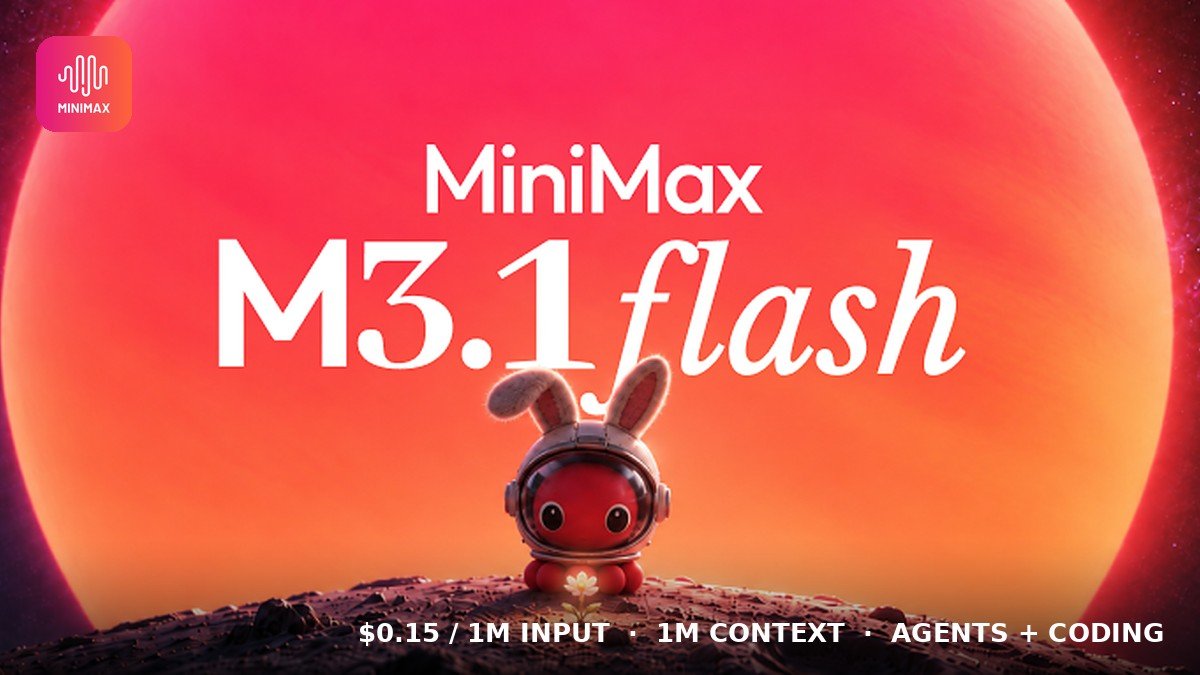
MiniMax has released M3.1 Flash, a cheaper and faster successor to its M3 model, aimed at agents, coding, computer use, and security work. It costs $0.15 per million input tokens and $0.60 per million output tokens, takes up to 1 million tokens of context, and is live now on the MiniMax API, the M Plan subscription, the MiniMax Code desktop app, and a rate-limited free endpoint on OpenRouter.
It also clears up a small mystery. MiniMax confirmed that Space Bunny, the anonymous model that had been running on OpenRouter, was an early build of M3.1 Flash. MiniMax says it handled more than 200 trillion tokens before anyone knew whose it was.
Deployability and license: M3.1 Flash is API-only at launch. MiniMax says weights will be released “later”. Press reports put the open-weight drop just days after launch, but MiniMax has not published a license yet, so it is too early to say whether you will be able to self-host it commercially. Benchmark scores below are MiniMax’s own unless marked as independent. 9to6AI has not run its own tests on the model.
What shipped
- Price: $0.15 input / $0.60 output / $0.015 cached input per 1M tokens, one flat rate. M3 cost $0.30 / $1.20, so the per-token price is half. MiniMax’s “70% cheaper” figure covers whole agent tasks, so it also counts the model using fewer tokens per job.
- Context and inputs: 1M-token window. The MiniMax docs list text, image, and video input. Artificial Analysis currently lists text and image.
- Thinking is always on. You can set
efforttolow,medium,high,xhigh, ormax, and it defaults tomax. If you try to turn thinking off, the API returns a 400 error. - Speed claim: nearly 3x faster inference than M3, 200+ tokens per second at peak, and 170+ at the median (P50). MiniMax credits more aggressive sparsity.
- Two API styles: an Anthropic-compatible endpoint (MiniMax’s recommended path) and an OpenAI-compatible endpoint. Existing SDK code mostly needs a new base URL and model name.
- Size: MiniMax’s launch post gives no parameter count. SiliconANGLE, citing MiniMax’s preview developer guide, reports 428 billion total parameters, about the same as M3.
The vendor-reported numbers
| Benchmark (MiniMax-reported) | M3.1 Flash | What it tests |
|---|---|---|
| DeepSWE v1.1 | 73.7% | Long software tasks with tests |
| Automation-Bench v1.0.6 | 62.2 | End-to-end SaaS business workflows |
| BankerToolBench | 76.2 | Multi-step finance work with chained tool calls |
| OSWorld V2 | 61.7 | Operating a desktop across apps |
| Agents’ Last Exam (ALE) | 29.6% | Real professional tasks (run in Claude Code at max effort) |
| CyberGym | 82% | Reproducing real software vulnerabilities |
For context, MiniMax’s own comparison charts (as reported by VentureBeat) put DeepSWE at 74 for Claude Opus 5, 73 for GPT-5.6 Sol, and 77 for DeepSeek V4.1 Flash-1017. So on coding, M3.1 Flash roughly matches older frontier models and trails DeepSeek’s latest Flash, which costs the same per token off-peak. MiniMax’s ALE chart estimates the full 152-task run at about $111, against several hundred dollars or more for the models near it on pass rate. Those are MiniMax’s estimates, run in its own harness.
What independent testing says
Artificial Analysis, which runs its own evals, is the most useful outside source so far:
- Intelligence Index: 43 at max effort, up from 29 for M3. That puts it in the same range as GLM-5.3 Flash (42) and Gemini 3.8 Flash (41), just behind DeepSeek V4.1 Flash-1017 (45).
- Cost per index task: about $0.22, down from about $0.51 for M3. That is the real-world effect of the price cut plus token use.
- Measured speed: about 123 tokens per second on MiniMax’s API. That is above average, but below the 170+ median MiniMax claims.
- Verbose: about 180M output tokens across the index, against a peer median of about 99M. A low per-token price can lose some of its edge if the model writes a lot.
The hallucination catch
On AA-Omniscience, Artificial Analysis’s factual-knowledge test, M3.1 Flash answered 56% of questions correctly. That is better than DeepSeek V4.1 Flash-1017 (43%) and GLM-5.3 Flash (28%). But it almost never says “I don’t know.” When it does not have the right answer, it gives a wrong answer instead of declining or giving a partial one. That is what the 93% hallucination rate means, and it pulls the overall Omniscience score down to 16.
The 93% does not mean 93% of its answers are wrong. It means that when the model is wrong, it is usually confidently wrong. For agents that update records, summarize filings, or research customers without a human checking, that matters more than a couple of points on a coding benchmark.
What builders are saying
The Hacker News launch thread is more skeptical than the charts. Several developers who used the model as Space Bunny inside OpenCode said it made noticeable errors and that they switched back to DeepSeek V4 Flash or Qwen 3.8 Flash Next. One called the model “benchmaxed”, meaning tuned for benchmarks more than real use. Others said it did well at documentation and organizing work but was less direct than DeepSeek on code. Simon Willison’s quick SVG test came out solid, and he noted that its reasoning traces are written in clipped, shorthand English.
None of that is a controlled test, but it fits what Artificial Analysis found: strong on paper and cheap, with more verification work for the person deploying it.
What it means for builders
- It is a real option for cheap agent volume. At $0.15 / $0.60 with 1M context and an Anthropic-compatible endpoint, you can try it in an existing Claude-style agent loop with very little code change. MiniMax documents setups for Claude Code and Cursor.
- Compare it with DeepSeek on your own tasks. Both list the same off-peak price. DeepSeek has MIT weights today and a higher independent index score. MiniMax wins on the AA factual-accuracy number and keeps the same price at all hours. Your own evals should decide.
- Lower
effortbefore deciding it is too slow or too expensive. The default ismax, which burns the most tokens. Many tool-calling steps will not need it. - Add guardrails for factual work. Given the hallucination profile, pair it with retrieval, schema validation, or a verifier step wherever a wrong answer is costly.
- Do not plan around self-hosting yet. The weights and license are still to come. If you need on-prem or a clear commercial license, wait for the actual release.
What to watch
- The open-weight release: the license terms, the real parameter and active-parameter counts, and whether quantized builds fit on 128GB workstations, as some HN commenters hope.
- Independent DeepSWE and OSWorld runs that check MiniMax’s coding and computer-use claims.
- Whether the hosted API holds the claimed 170+ tokens per second under launch-week load.
- The M3.1 Pro model MiniMax says is coming next.
- Procurement scrutiny of Chinese models in the US. A Department of Homeland Security order removing DeepSeek products from federal civilian agencies was made public the same week. It names DeepSeek only, but teams selling into government should keep an eye on it.
Key takeaways
- MiniMax M3.1 Flash is live on the MiniMax API, M Plan, MiniMax Code, and a free rate-limited OpenRouter endpoint, at $0.15 / $0.60 per 1M tokens with 1M context.
- It was the anonymous Space Bunny model, which MiniMax says served more than 200 trillion tokens.
- Vendor-reported: 73.7% DeepSWE v1.1, 61.7 OSWorld V2, 76.2 BankerToolBench, 82% CyberGym.
- Independent (Artificial Analysis): Intelligence Index 43, about $0.22 per task, about 123 tokens per second, verbose output, and a 93% AA-Omniscience hallucination rate.
- Weights are promised but not out, and there is no license yet. Thinking cannot be disabled; use
effortto control cost. - 9to6AI has not tested the model itself. Run it on your own workloads before switching production traffic.
Sources
- MiniMax: M3.1 Flash launch post
- MiniMax API docs: model invocation, effort levels, thinking
- MiniMax API pricing
- Artificial Analysis: MiniMax-M3.1-Flash
- VentureBeat: independent results and hallucination findings
- SiliconANGLE: launch coverage and Space Bunny background
- Hacker News launch discussion
- OpenRouter: MiniMax M3.1 Flash (free)