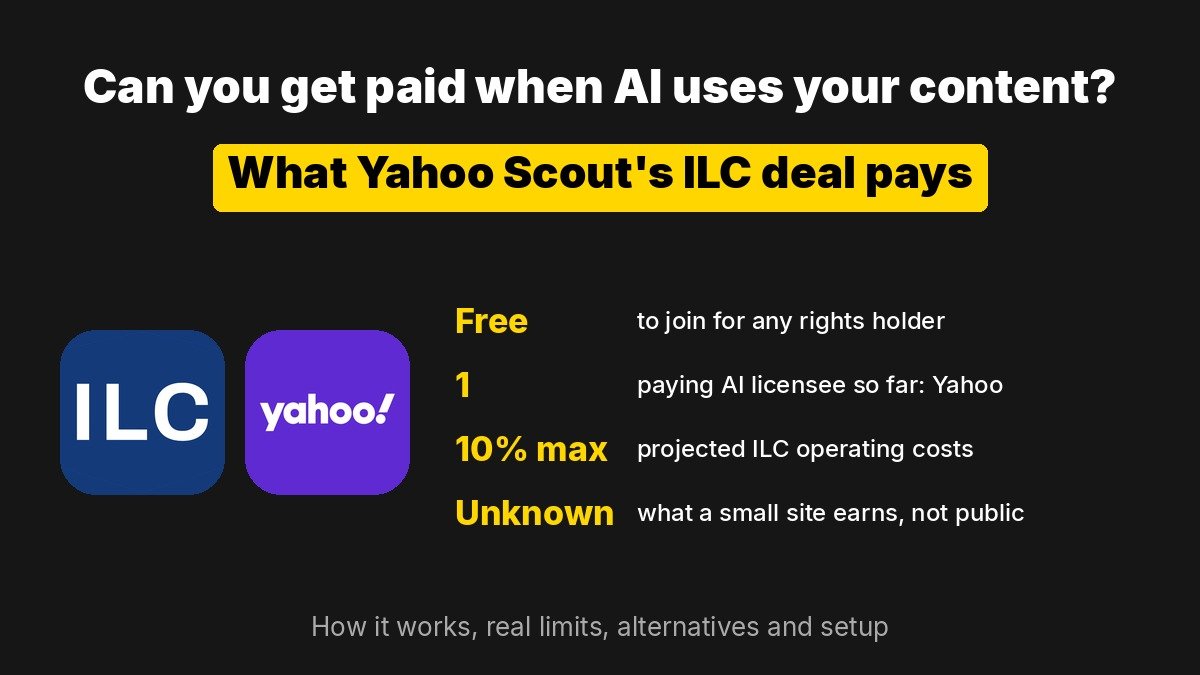
Short answer: Yes, a website owner can now sign up to be paid when AI answers use their work, but nobody has published what a small site actually earns yet. The new Internet Licensing Collective (ILC) is free to join, and Yahoo Scout is its first paying AI customer, sharing a blanket fee among publishers based on how their content is used. Treat it as a small, free extra revenue line to set up once, not as income you can plan around.
What just launched?
A nonprofit group of more than 3,000 media brands, content owners and publishing platforms launched the Internet Licensing Collective, formerly called the RSL Collective. Its first commercial licensee is Yahoo Scout, Yahoo’s AI answers tool. Through the deal, Yahoo pays to use content from participating publishers to inform its answers, and that money is passed on to the publishers whose work was used.
Members listed on the ILC site include The Guardian, Stack Overflow, Medium, Wikipedia, wikiHow, WebMD, CNET, BuzzFeed and O’Reilly Media. The coverage at Search Engine Roundtable and Digiday is why site owners are asking whether this is a real income stream or another press release.
What makes it relevant for independent creators is the FAQ: any website owner, publisher or creator who holds the rights to their content can join, and joining costs nothing.
How does the ILC actually pay publishers?
The model works like collective licensing in music. An AI company pays one blanket fee for access to everything in the collective, and the ILC splits that money among publishers using published allocation rules. Here is the flow described in the ILC publisher onboarding guide:
- You decide which content to license and which to exclude.
- You publish an RSL (Really Simple Licensing) file with your terms and add a
License:line to robots.txt so AI systems can find it. - You enroll your site and subdomains in the ILC Publisher Portal.
- The AI company uses the licensed content, tracks that use, and sends the ILC both a payment and a usage report.
- The ILC applies its allocation rules and pays you for the reporting period, with usage data in your dashboard.
According to the ILC FAQ, your share depends on three things: how your work contributes (shaping an answer, grounding it or being cited counts for more), how often AI relies on it, and how valuable the AI product is. Digiday reports that each AI company’s money goes into its own royalty pool, so a niche site used by a specialized, higher value AI product is not diluted by the huge general pool.
The ILC says it runs at cost, with operating expenses projected at or below 10%, and the rest goes to rights holders. Participation is non exclusive, so you keep any direct deals and can still license elsewhere.
How much can a small website realistically earn?
Nobody can answer that honestly yet, and you should be wary of anyone who gives you a per page figure for the ILC today. Here is what is and is not public:
| Question | What is public |
|---|---|
| How much is Yahoo paying? | Not disclosed. Digiday reports the fee is tied to Yahoo’s revenue from the product. |
| What does a typical publisher receive? | Not published. The exact allocation formula is also not disclosed. |
| How many AI companies pay? | One so far. The ILC says it is in talks with others but has not named them. |
| How big could this market get? | Mather Economics estimates AI companies could pay 15% to 35% of their revenue for licensed content. That is a model based estimate, not money anyone has paid. |
| What does the ILC keep? | Operating costs, projected at or below 10%. |
The practical read: one licensee, an undisclosed fee and thousands of publishers sharing it means early payments to a small blog are likely to be modest. The upside is optional. If more AI companies sign the same blanket license, an enrolled site starts earning from them too without new paperwork.
For comparison, the other open routes show how small per use pricing is. Cloudflare lists a minimum of $0.001 per crawl for Pay Per Crawl, and AntiMedia’s breakdown shows the arithmetic: 10,000 paid requests at that price is $10, and 1,000,000 is $1,000. Those are hypothetical volumes, and paid requests are far rarer than bot visits in your logs.
How does the ILC compare with other ways to get paid by AI?
These programs pay for different events, so they can be combined. This table covers the options a site owner can realistically look at now, based on each provider’s own pages and reporting.
| Program | How you get paid | Who can join | Cost to you | Main catch |
|---|---|---|---|---|
| ILC (Yahoo Scout first) | Share of a blanket fee per AI company, by how your content is used | Any rights holder, sites of any size | Free | One licensee so far, no published payout data |
| Cloudflare Pay Per Use | Buyer pays a set price each time it uses your content; paid monthly | Cloudflare customers, beta | Free to opt in; site must be on Cloudflare | Beta, usage is self reported by buyers |
| Cloudflare Pay Per Crawl | Charge per successful crawl, minimum $0.001 | Closed beta, apply | Needs Cloudflare DNS and a dedicated Stripe Connect account | Bots can simply leave instead of paying |
| TollBit | You set rates per 1,000 pages for summarization or full display licenses | Publishers, onboarding open | No revenue share; buyers pay a fee on top | Needs a bot paywall setup; demand depends on which AI buyers use it |
| Amazon Content Partners | Benefits, not a share: +1% on eligible Amazon Associates sales, Amazon Publisher Services ads, $100 a month in AWS credits | US based independent creators only | Free, no traffic minimum | You grant Amazon continued access; no payment per AI use |
Perplexity’s Comet Plus and ProRata’s Gist pay stated revenue shares, but industry reporting describes them as named partner rosters rather than open sign ups, so most small sites cannot count on them.
What does it cost, and what can go wrong?
The cash cost of joining the ILC is zero. The real costs are time and decisions:
- Setup time. Writing an RSL file, editing robots.txt and enrolling each domain and subdomain. On WordPress this is usually a small file upload plus a robots.txt edit through your SEO plugin or host.
- Licensing more than you meant to. The ILC’s example declaration permits
ai-allfor the whole site. If you do not want your work used for training, read the RSL specification and license only the uses you are comfortable with, or exclude sections. - Rights you do not hold. You confirm you have the rights to license what you enroll. Guest posts, syndicated articles and stock images may not be yours to license.
- Traffic trade offs. Getting paid for AI use does not buy citations, rankings or visitors. Track organic clicks and referrals separately so a licensing win does not hide a traffic loss.
- Unknown payout terms. The FAQ says payments arrive on a regular schedule to the payout method on your account, but minimums and timing for small accounts are not spelled out publicly. Check them in the portal before counting on anything.
How do you set this up on your own site?
- Audit what you own. List the sections that are original to you, such as tutorials, tests, data and reviews, and mark anything syndicated or contributed by others for exclusion.
- Create an ILC account through the ILC site and read the current license terms before enrolling.
- Write your RSL file. Start from the onboarding guide examples, choose the paths and uses you want to license, and host the file on your domain, for example
/rsl.xml. - Add the License line to robots.txt, such as
License: https://yoursite.com/rsl.xml, on every domain and subdomain you enroll. Keep your existing crawler rules intact. - Enroll the sites in the Publisher Portal and add your payout details.
- Stack what fits. If you are on Cloudflare, review Pay Per Use offers in the dashboard. If you are US based and use Amazon Associates, compare Amazon Content Partners. If you want to price bot access yourself, look at TollBit.
- Measure for a few reporting periods. Compare dashboard earnings with your organic traffic and affiliate income before you expand or drop anything.
Who is this a good fit for?
Good fit: independent bloggers, niche experts and small publishers with a real archive of original work, especially content that AI tools need to ground answers, such as how to guides, product tests, local information and specialist data. It suits people who want a free, low maintenance add on to ads and affiliate income.
Poor fit: sites built on rewritten news or thin AI generated pages. The allocation rules reward content that shapes or is cited in answers, and generic content has plenty of substitutes. It is also a poor fit for anyone who needs predictable income soon, because there is one paying licensee and no public payout history.
What should you watch next?
- More licensees. The ILC says it is talking with major AI companies. Each new one adds a separate royalty pool for enrolled sites.
- First payout reports. Real numbers from small publishers will show whether this is worth more than an evening of setup.
- Pay per use pilots. Microsoft’s Publisher Content Marketplace and Cloudflare Pay Per Use are both testing payment for grounded answers rather than flat fees.
- Allocation transparency. The ILC has published the factors but not the formula. Watch for whether dashboards show enough detail to check what you are paid.