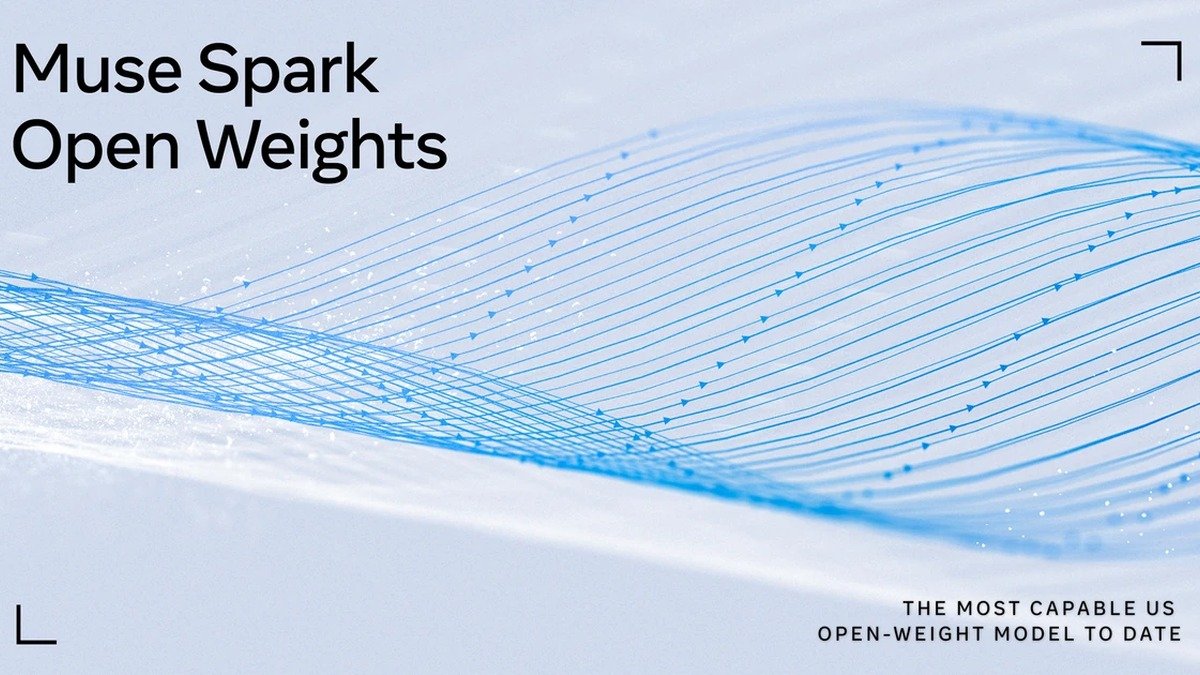
Meta has released the weights for Muse Spark Open, an 816-billion-parameter multimodal mixture-of-experts model with about 42 billion parameters active per token and a one-million-token context window. Meta Superintelligence Labs positions it as the most capable US open-weight model to date, aimed at coding agents and long-horizon tool use. Weights are on Hugging Face (BF16 and NVFP4), and hosted APIs are live on Baseten, Fireworks AI, Groq, Modal, Nebius, OpenRouter, and Together AI.
The drop topped Hacker News the day it landed, alongside debate over desktop hardware needs, the Muse Model License, and how the vendor table compares with Chinese open-weight leaders. Numbers and product claims below come from Meta’s announcement, the Hugging Face model card, Hugging Face’s same-day guide, and that discussion. 9to6AI has not hands-on tested Muse Spark Open yet.
Earlier 9to6AI coverage tracked Muse Wonder, Meta’s closed frontier agent models on the Meta Model API and Muse Code. This piece is about the open-weight Spark release, not a rehash of Wonder pricing or the Full tier that stays off the public API.
Key points
- Size: ~816B total parameters, ~42B active per token (256 experts, top-8 routing), 62 layers, 1M-token context at inference.
- Modalities: Text, image, video, and audio in; text out. A 1.8B Perception Encoder handles vision; a separate audio encoder emits tokens at 12.5 per second.
- Where to run: Self-host via SGLang, vLLM, TensorRT-LLM, Transformers, llama.cpp, Unsloth, or Apple MLX; or call a hosted partner API.
- Desktop path: Meta and Apple optimized a two–Mac Studio (M5 Ultra) MLX setup so the full model can run locally on about a terabyte of unified memory.
- License: Muse Model License — free for many uses with mandatory “Built with Muse Spark Open” attribution; MaaS providers above $20M trailing 12-month revenue need a separate Meta agreement.
- Benchmarks (Meta table, xhigh reasoning): Strong on MCP-Atlas (89.2) and JobBench (61.8); Artificial Analysis Intelligence Index 39, behind GLM 5.3 (45), Kimi K3 (44), and Qwen3.8 (40) in that same table.
What Meta shipped
Meta’s research blog post frames Muse Spark Open as an open-weight model built for coding and agentic work: multi-file software engineering, multi-step tool use, and long coherent plans. The model card on Hugging Face lists recommended use cases that include coding agents, tool use across multi-turn workflows, multimodal reasoning over screenshots and recordings, synthetic data generation, and LLM-as-a-judge evaluation.
Architecture details that matter for deployers:
- MoE block with 256 experts, 8 active per token; only the active slice runs compute, but all experts stay in memory.
- BF16 checkpoint is roughly 1.5 TB in safetensors; NVFP4 targets NVIDIA Blackwell with much lower VRAM (Meta cites about 700 GB for NVFP4 vs ~2 TB for BF16).
- Reasoning effort is low / medium / high / xhigh (default xhigh). Reasoning cannot be turned off; use low for cheaper, shorter turns.
- Recommended sampling for most deployments: temperature 1.0, top_p 1.0, top_k disabled.
Meta says the open-weight checkpoint received extra safety post-training for standalone use without product guardrails, and that it met Meta Superintelligence Scaling Framework thresholds for release. The model card still tells deployers to add system-level guardrails, especially when the model can take real-world actions.
On Apple silicon, Meta describes agentic demos running entirely on-device with Muse Code powered by Muse Spark Open — including shipping changes to the open-source Mastodon client Ice Cubes and driving DaVinci Resolve with frame-by-frame review. Those are vendor demos, not independent audits.
Hugging Face’s developer guide adds day-one recipes for Transformers, llama.cpp quants, SGLang, vLLM, MLX, Inference Endpoints, and TRL LoRA fine-tuning with experts frozen.
Hardware and license reality for builders
Active parameters make each token cheaper to compute. They do not shrink the memory footprint. Anyone planning self-host should budget for multi-GPU servers or a dual Mac Studio cluster, not a single consumer GPU.
Practical paths Meta and partners call out:
- Hosted API: Fireworks, Together, Groq, Baseten, Modal, Nebius, OpenRouter — useful if you want Spark without buying a cluster.
- Cloud catalogs: Amazon SageMaker AI, Google Cloud Model Garden, Microsoft Foundry Models.
- Local / on-prem: NVFP4 on Blackwell-class nodes; llama.cpp and MLX quants for Apple Unified Memory machines with hundreds of GB free; Helion GPU kernels in SGLang for NVIDIA and AMD speedups Meta reports in the 1.03–3.95× kernel range.
The Muse Model License is permissive for many builders and restrictive for some businesses:
- Use, modify, fine-tune, distill, distribute, and sell are allowed under the license text Meta published with the weights.
- Products and derivatives must prominently display “Built with Muse Spark Open”.
- If you offer the model (or derivatives) as Model-as-a-Service and your aggregate gross revenue with affiliates exceeds $20 million in any consecutive 12 months, you must notify Meta and sign a separate agreement before including it in that MaaS offering. Internal use, research, and embedding Spark inside your own non-MaaS product are carved out.
- A usage policy lists prohibited uses; Meta says the model is not intended for people under 18.
Hugging Face gated access asks for legal name, date of birth, and organization before the download unlocks. Read the full license on the model card before you commit engineering time.
How the benchmarks read (and what they don’t)
Meta’s comparison table (xhigh, temperature 1.0) puts Muse Spark Open near the front of US open-weight peers on several agentic and tool-use scores, while Chinese open-weight models still lead Meta’s own Artificial Analysis Index and Terminal-Bench rows:
| Signal | Muse Spark Open | Context from Meta’s table |
|---|---|---|
| MCP-Atlas | 89.2 | Highest in the published table (Scale AI) |
| JobBench | 61.8 | Edges GLM 5.3 (61.4); well above Qwen3.8 (52.7) |
| Artificial Analysis Intelligence Index | 39 | Behind GLM 5.3 (45), Kimi K3 (44), Qwen3.8 (40) |
| Terminal-Bench 2.1 (Terminus 2) | 76.4 | Behind Kimi K3 (85.0), GLM 5.3 (83.9), Qwen3.8 (82.0) |
| StrongREJECT v2 (adaptive, lower better) | 0.5 | Meta-internal; other listed models sit in the 60s–80s |
Treat DeepSWE and similar self-reported harness scores as non-comparable across vendors — Meta says other labs’ numbers use preferred harnesses. A full evaluation methodology PDF is linked from the research post; Meta says a fuller report is still coming. Independent third-party re-runs will matter more than the launch table.
What it means for builders
For teams that want frontier-class open weights under US control, Muse Spark Open is the clearest Meta answer since Llama 4-era releases — and a different product from Muse Wonder. Wonder is the hosted agent stack with API pricing and a Full tier that stays off the public API. Spark is the weights you can download, quantize, fine-tune, and (within license limits) serve yourself.
Choose Spark when you need:
- On-prem or VPC inference with multimodal agent loops (screenshot + code + tools).
- Fine-tunes or distillations under a license you can actually read end-to-end.
- A US open-weight option that is competitive on tool-use benches even if it trails GLM/Kimi/Qwen on some general indexes.
Skip or postpone local Spark when:
- You only need an API and Wonder (or another frontier API) already fits the budget.
- You cannot provision ~700 GB+ of accelerator memory (or two high-memory Mac Studios).
- Your business is MaaS above the $20M threshold and you have not lined up Meta’s commercial side letter.
Reasoning always on is a cost and latency fact, not a toggle. Pin effort to low for trivial prompts; reserve xhigh for hard agent runs. Do not expose raw chain-of-thought to end users without your own filters — Meta’s card calls that out explicitly.
What to watch
- Meta’s promised full evaluation report and independent Artificial Analysis / community re-runs.
- Quality of community quants (llama.cpp, MLX oQ) versus BF16/NVFP4 reference.
- How strictly Meta enforces the $20M MaaS clause and attribution on derivatives.
- Whether dual Mac Studio + MLX becomes a realistic path once 512 GB M5 Ultra configs are widely available.
- Follow-on open US models (including Mistral Large 4 weights Meta’s table already references as forthcoming).
Sources
- Meta: Introducing Muse Spark Open
- Hugging Face: Muse-Spark-Open-816B-A42B model card
- Hugging Face: Welcome Muse Spark Open
- Meta: Muse Spark Open evaluation methodology
- Hacker News discussion
Image credit: Meta