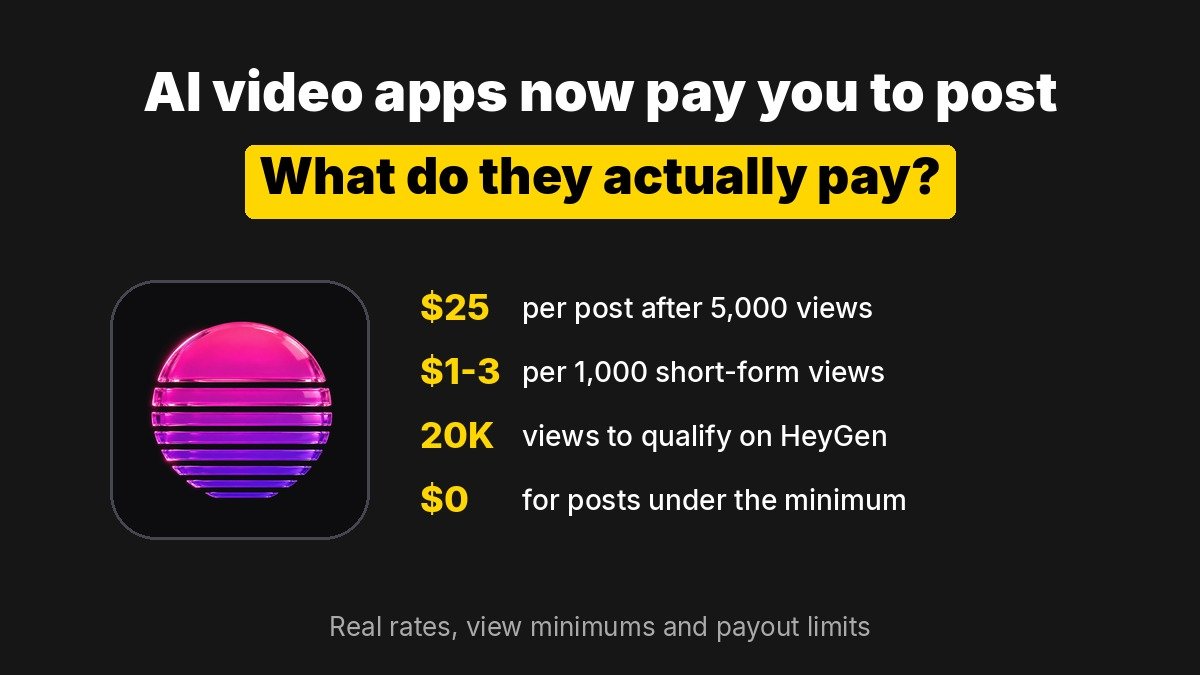
Short answer: Yes, a growing list of AI video apps now pays ordinary creators to post videos made with their tools, and several new programs opened in the past week alone. The pay is real but small for most people: you typically earn only once a post clears a view minimum, short-form rates mostly sit between $1 and $3 per 1,000 views, sometimes with a flat bonus on top, and payouts are capped per video. It suits people who already make short-form video and can post several times a week; it is not predictable income.
What changed this week?
AI video and creative tools have started paying for distribution the way brands pay influencers, but with published rate cards and no follower minimum in most cases. Aristotto opened its Creator Partner Program, where every approved post earns a guaranteed amount plus a rate per 1,000 views up to a cap. Diaflow launched a creator program with a 30% recurring affiliate commission and credit top-ups. CONTINUUM AI’s OrcaRouter Ambassador Program gives creators with 1,000+ followers $50 a month in inference credits for weekly posts.
They join programs that already publish their rates, such as ClickPop Earn, HeyGen Insiders and the VMEG Creator Fund. The pattern is the same everywhere: the app gets reach on Instagram, TikTok, YouTube or X, and you get paid on approved posts and the views they earn.
What do these programs actually pay?
These are the rates each company publishes on its own program page. They change often, so check the live page before you start.
| Program | What you post | Published pay | Main catch | How you are paid |
|---|---|---|---|---|
| ClickPop Earn | Original videos made in ClickPop, on Instagram Reels, TikTok or YouTube Shorts | $25 per approved post once it reaches 5,000 views, plus $1.50 per 1,000 views, capped at $500 a post | Below 5,000 views a post earns nothing; a person reviews every post and account | Cash via Stripe in 107 countries, from a $20 balance |
| HeyGen Insiders | Short videos about each new HeyGen release, posted within a week of launch | Paid per 1,000 views on posts that pass 20,000 views in 7 days; no public per-view rate | Needs 1,000+ followers on one platform and an approved application | PayPal after each launch window closes |
| VMEG Creator Fund | A video fully about VMEG.AI, the dubbing and translation tool | YouTube videos of 3+ minutes: $10 per 1,000 views from 1,000 views, up to $600; TikTok and Shorts: $3 per 1,000 from 2,000 views, up to $300; double past 500,000 views | Two videos a month at full rate, then 30%; must include your affiliate link | Paid in the first 10 working days of the next month |
| Ootto | Instagram Reels that show or mention Ootto | $1 per 1,000 counted views, rising to $1.50, $2 and $3 at 50,000, 250,000 and 1,000,000 lifetime views | Instagram only; needs a creator or business account | Monthly through Whop |
| Aristotto | Videos made in Aristotto, on Instagram, YouTube or X | Guaranteed amount per approved post plus a per-1,000-view rate and cap, set per campaign | Rates only visible inside the app; admin approval to join | Cash in the US, Canada, UK, EU, Switzerland, Norway, Iceland and Liechtenstein; credits everywhere else |
| Flikk | Videos about a game you made in Flikk | $5 per approved video plus view bonuses, up to $605 a video | Rewards are Flikk Points, not cash | Gift cards redeemed in the app |
| Vidu Earn | AI videos and films made with Vidu | Cash and credit rewards by tier; no public rates | Application form; rewards tied to events and missions | Not published |
How much can you realistically earn?
None of these companies publishes what a typical creator makes, so treat every number below as arithmetic on published rates, not a forecast.
ClickPop’s own example: a post with 10,000 views on day 7 pays $25 + 10 × $1.50 = $40. If you post 10 videos in a month and only 4 clear 5,000 views at about 12,000 views each, that is 4 × ($25 + $18) = $172, and the other 6 earn nothing. On VMEG, a 3-minute YouTube video with 20,000 views would earn $200, but only your first two videos each month get the full rate.
The one program with a public total is Picsart. It said in a Business Wire release that its Earn program paid more than $1 million in under two months to a community of over 80,000 registered creators, with top creators earning up to $10,000 a month. That works out to roughly $12.50 per registered creator on average, which tells you the money is heavily concentrated among a small group who post often and hit with formats that travel.
| Scenario (published rates) | Views | Payout |
|---|---|---|
| ClickPop post under the minimum | 4,800 | $0 |
| ClickPop post | 10,000 | $40 |
| ClickPop post at the cap | about 317,000 | $500 |
| Ootto Reel, new creator | 20,000 | $20 |
| VMEG 3-minute YouTube video | 20,000 | $200 |
| HeyGen Insiders post | 19,000 in 7 days | $0 (below 20,000) |
Does it matter where you live?
Yes, more than most guides admit. Aristotto pays cash only in the US, Canada, the UK, the EU and a few European countries; everyone else gets credits. ClickPop pays through Stripe in 107 countries and runs a waitlist where Stripe cannot pay yet, so check its country tool before you spend time. HeyGen pays by PayPal, so you need a PayPal account that can receive money. Flikk pays in gift cards. If you live outside the main Western markets, confirm the payout route first, or you may end up working for credits.
What does it cost, and what can go wrong?
- Tool costs. ClickPop says you do not need a studio plan to join Earn, but serious AI video work usually needs paid credits on most tools. Work out your cost per video before you subscribe.
- Your feed becomes an ad channel. VMEG requires the whole video to be about its product. Ootto requires a genuine mention and your link. Too much sponsored content can hurt the audience you are building.
- Clawbacks. ClickPop takes back money paid on posts that broke the rules, and every program bans bought or bot views. Posts usually must stay up for a set period, for example 30 days on ClickPop.
- Disclosure and platform rules. Label AI-generated video where the network asks, and follow advertising disclosure rules for paid promotion. YouTube’s monetization policy also targets mass-produced, repetitive AI content, so a channel full of near-identical clips is at risk.
- Likeness and copyright. Do not use real people’s faces or voices without permission, and never recut someone else’s footage. ClickPop’s rules ban both.
- Moving targets. Campaigns open and close, rates are set per campaign, and budgets can run out. A rate that pays today may not exist next month.
How do you start without wasting time?
- Pick the platform you already post on. ClickPop takes Reels, TikTok and Shorts; Ootto is Instagram only; HeyGen and Aristotto include X; VMEG pays best for 3-minute YouTube videos.
- Check the payout route for your country first. Cash or credits, Stripe or PayPal, and the minimum withdrawal.
- Read the live brief. Required mentions, hashtags, length and how long the post must stay up decide whether you get paid at all.
- Make 3 to 5 test videos. Copy the campaign’s reference format, then add your own angle. Track which ones clear the view minimum.
- Keep a simple sheet. Log tool costs, time per video, views and payouts. If your hourly rate is poor after a month, stop or switch programs.
- Use the work as a portfolio. The steadier money is often selling AI video work to clients directly. Demand for that is rising, as we covered in AI Freelance Work Grew 55% on Upwork.
Who is this a good fit for?
| Good fit | Poor fit |
|---|---|
| People already posting short-form video several times a week | Anyone who needs predictable monthly income |
| Creators who want paid practice with AI video tools | People who do not want brand content on their own account |
| Small accounts with formats that sometimes travel | Anyone planning to farm views or repost others’ clips |
| Creators in countries with Stripe or PayPal payouts | Creators where the only reward on offer is credits |
What should you watch next?
Watch whether these companies start publishing median creator earnings, which would show if the model works beyond a lucky few. Also watch how YouTube, TikTok and Instagram treat a wave of near-identical sponsored AI clips; stricter originality enforcement would hit this model first. Until then, the honest read is simple: these programs pay for views you actually get, most posts earn little or nothing, and the people who win treat it as a volume skill rather than passive income.
Image credit: ClickPop