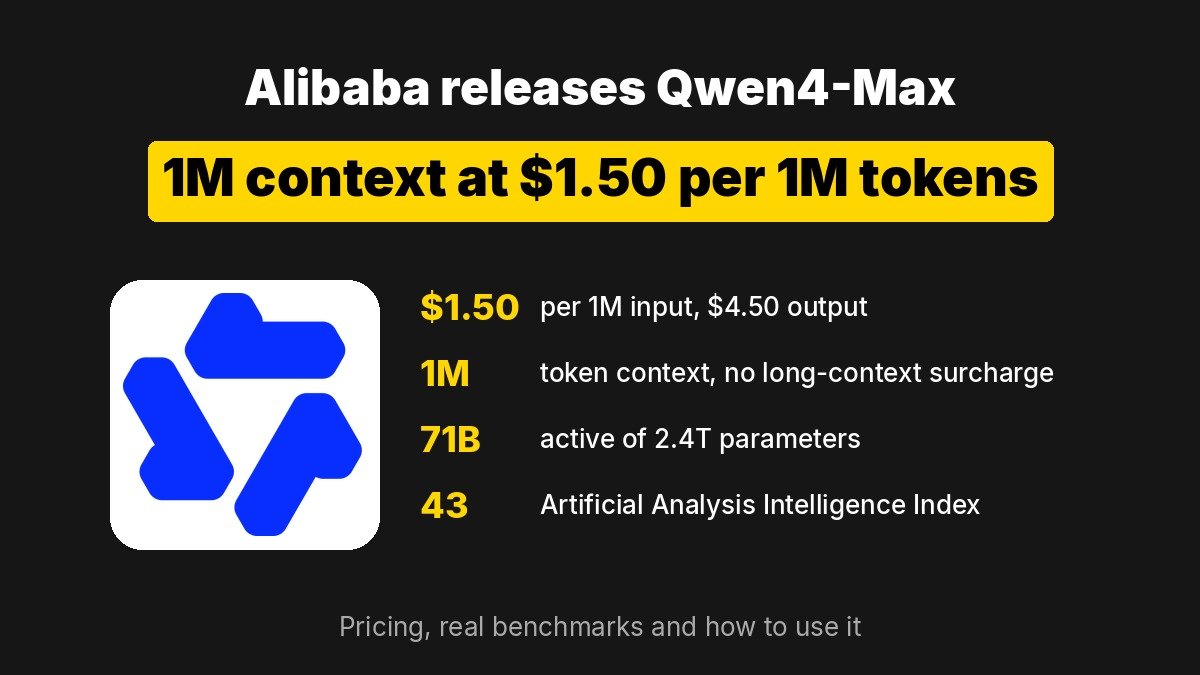
Short answer: Alibaba has made Qwen4-Max, its new flagship model, generally available on QwenCloud. It is a 2.4 trillion parameter mixture of experts model that activates 71 billion parameters per token, reads text, images and video, and handles a 1 million token context. API pricing is $1.50 per million input tokens and $4.50 per million output tokens in Alibaba’s Singapore region, lower than Qwen3.8-Max, with no long context surcharge. It is not open weights, and independent scores so far are good but not frontier leading.
Key points
- Qwen4-Max is Alibaba’s new flagship, generally available through the QwenCloud API, Token Plan, Qwen Studio, QwenWork and Qoder.
- It is a 2.4 trillion parameter mixture of experts model with 71 billion active parameters per token and a 1 million token context.
- API pricing in Singapore is $1.50 per million input tokens and $4.50 per million output tokens, below Qwen3.8-Max, with no long context surcharge.
- Thinking tokens bill as output, thinking defaults to high effort, and batch inference is not supported.
- It is API only with no open weights, and Artificial Analysis places it 38th of 81 models on its Intelligence Index.
What did Alibaba ship?
According to Alibaba’s announcement, Qwen4-Max is the first model in the Qwen4 family and the most capable Qwen model to date. It moved from a limited, Token Plan only preview to general availability, and it is live through the QwenCloud API, Token Plan, Qwen Studio, QwenWork and Qoder.
The Qwen launch post hit the top of Hacker News with about 590 points and roughly 250 comments, which is why developers are talking about it today.
The headline specs, from QwenCloud’s model docs:
- Architecture: sparse mixture of experts, 2.4 trillion total parameters, 71 billion active per token. Alibaba says that is 25% fewer active parameters than Qwen3.8-Max at the same total size.
- Inputs: text, images, video and PDFs, with native vision rather than a bolted on adapter.
- Context: 1 million tokens. Up to 262,144 tokens of thinking plus answer, or 131,072 tokens of output with thinking off.
- Tools: function calling, parallel tool calls, structured output, web search, code interpreter, web scraping and MCP.
- Reasoning effort: low, high (the default) and xhigh.
Alibaba also released a Qwen Live Delivery plugin that lets an agent hand over a usable first version of a task and keep updating it, so you can review and redirect long jobs instead of waiting for one final answer.
How much does Qwen4-Max cost?
QwenCloud publishes two price columns. Thinking and non thinking modes cost the same, and there are no input length tiers, so a 900K token request is billed at the same per token rate as a 9K one.
| Billing item (per 1M tokens) | Singapore (International) | Global (incl. US Virginia) |
|---|---|---|
| Input | $1.50 | $1.413 |
| Output (thinking + answer) | $4.50 | $4.24 |
| Cache write, 5 minute TTL | $1.875 | $1.767 |
| Cache write, 1 hour TTL | $3.00 | $2.827 |
| Cache read | $0.075 | $0.071 |
Source: QwenCloud pricing. The Global deployment runs in Frankfurt, Hong Kong, Tokyo and US (Virginia), which matters for US teams that care about latency or where inference happens. Pay as you go calls in Singapore include 1 million free tokens.
Two billing details to plan around. Thinking tokens are billed as output, and thinking is on by default at high effort, so a chatty reasoning run costs more than the input price suggests. And batch inference is listed as not supported for Qwen4-Max, so you cannot use the usual 50% batch discount on it.
A rough example, using our own math on the Singapore prices: an agent step that sends 200K tokens of context and gets 20K tokens back costs about $0.39. If 150K of that context is a cached prefix, the same step drops to about $0.18.
How does Qwen4-Max compare with Qwen3.8-Max?
| Item | Qwen4-Max | Qwen3.8-Max |
|---|---|---|
| Input price, Singapore (per 1M) | $1.50 | $2.00 |
| Output price, Singapore (per 1M) | $4.50 | $6.00 |
| Total parameters | 2.4T | 2.4T |
| Active parameters per token | 71B (25% fewer, per Alibaba) | Higher |
| Tokens used on Work360, high effort | 35% fewer, per Alibaba | Baseline |
| Average cost per Work360 task | RMB 11.16 | RMB 26.58 |
Work360 is Alibaba’s own benchmark of industry tasks across 721 specialized fields, so treat the roughly 58% to 60% cost cut as a vendor claim. The RMB figures come from TechNode’s report on the launch.
How good is it, really?
Alibaba says Qwen4-Max ranks 6th on Code Arena, a live coding leaderboard, and posts strong results on agent and workplace benchmarks including Agents’ Last Exam, Vals Index, JobBench and Chartography. Its showcase examples are ambitious: a 48 hour agent run that helped find an experimentally validated chip coolant molecule, and a machining workflow where programming time fell from about 475 minutes to 24.
The independent picture is more modest. Artificial Analysis lists Qwen4-Max at 43 on its Intelligence Index, 38th of 81 models it tracks. Hacker News commenters were blunt: several called the result disappointing for a 2.4T model this late in the year, and one developer said speed was the real problem with Qwen 3.8, at around 30 tokens per second in their tests. Artificial Analysis had not yet published a speed figure for Qwen4-Max.
Our read: Qwen4-Max is a price and efficiency upgrade first, not a new leader. That is still useful if you run long context or agent workloads where cost per task matters more than the last few benchmark points. For other recent models in a similar price band, see our breakdowns of Kimi K3.1 Pro and Gemini 4 Hydrogen.
How do you use Qwen4-Max today?
It is API only. There are no open weights for Qwen4-Max, and fine tuning is not supported. Alibaba says smaller open weight Qwen4 models are coming soon, and that is what many local model users are waiting for. Until then, a local option in the family is Qwen3.8-Flash-Next, which Strata runs on a 12 GB gaming GPU.
- Existing code: QwenCloud exposes OpenAI Chat Completions, OpenAI Responses and Anthropic Messages compatible endpoints, plus its own DashScope API. Set the model ID to
qwen4-maxand point your client at the QwenCloud base URL. - Coding tools: QwenCloud documents setups for Claude Code, Codex and OpenCode, through Token Plan or pay as you go keys.
- Caching: a new explicit cache lets you pin system prompts, tool definitions and reference docs with a 5 minute or 1 hour TTL, which is where most of the savings in agent loops come from.
- Preview users: the separate
qwen4-max-previewmodel is retired when its preview window ends, so switch toqwen4-maxnow.
What should builders watch?
- Real speed. Throughput decides whether this works in an interactive coding agent. Measure tokens per second on your own prompts before switching.
- Thinking costs. Default high effort can multiply output tokens. Test low effort for routine steps and keep high or xhigh for hard ones.
- Data and policy fit. This is a hosted model from a Chinese provider, and some HN commenters probed how it answers politically sensitive questions. Check your data residency rules and content needs before sending customer data.
- The open weight drop. If the smaller Qwen4 models keep the efficiency gains, they could matter more to most builders than Max itself.
The practical move this week: run Qwen4-Max side by side with your current model on ten real tasks, log cost per task with caching on, and decide on numbers, not launch charts.